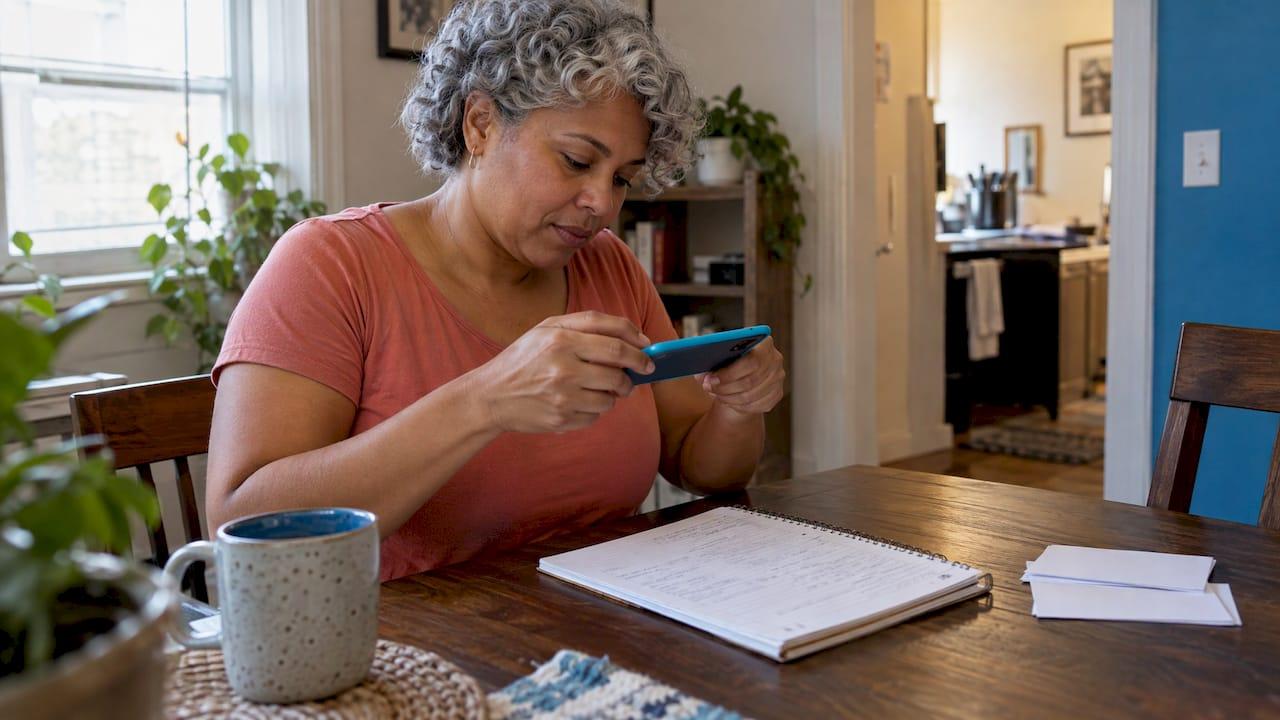
You can turn scanned notes into flashcards in four moves: capture the page cleanly, convert it to text, rewrite each fact as a question with a short answer, then check every card against your source. The scan is the easy part. The cards only help your recall if each one asks one thing, in the way an exam would ask it. RecallOS is built for this: you upload your own notes in Upload Notes and get flashcards, quizzes and summaries from them, made by a platform developed by practicing nurses and CRNAs.
This guide is for nursing students, pre-nursing students, healthcare professionals preparing for certification, and CRNA candidates. It shows how to get a messy lecture page into a deck you can trust.
TL;DR
- Capture each page flat, evenly lit and in a document or whiteboard mode, then convert it to text and proofread it before anything else.
- Turn facts into one-question, one-answer cards, and rewrite them to match how your exam asks, not how your professor lectured.
- Check every generated card against your original notes and a trusted nursing reference before you study it.
- Review in short daily sessions, and put the cards you miss back in front of you sooner.
- RecallOS builds flashcards, quizzes, summaries and exam predictions from the notes you upload, and reviews your weak areas for you.
Table of Contents
- Why scanning notes is worth the effort
- Step 1: Capture the page so the text can be read
- Step 2: Convert the image to text and proofread it
- Step 3: Turn text into cards that test recall
- Step 4: Check every card before you study it
- Step 5: Organize the deck so you can find your gaps
- Step 6: Review in short daily sessions
- Putting it together: a 15-minute example
- Beyond flashcards: quizzes and summaries from the same notes
- Perspective: what we think matters most
- Let RecallOS do the conversion and the review
- FAQ
- Sources
Why scanning notes is worth the effort
Most nursing students already have the raw material: lecture slides, handwritten pages from skills lab, printed handouts, a pharmacology outline from a study group. The problem is that notes are built for listening, not for recalling. Reading them again feels productive but asks nothing of your memory.
Flashcards flip that. A card forces you to pull the answer out of your head before you see it. That is the idea behind active recall, which we explain in plain English in our guide to active recall for nursing students. Scanning is simply the fastest way to move your own material into that format, so you study what your program actually taught rather than a generic deck.
There is a second reason to start from your own notes. Your instructors write exam questions from the content they taught. A deck built from your notes mirrors that emphasis, and for the NCLEX you can then add practice on top of it, as we describe below.

Step 1: Capture the page so the text can be read
Everything downstream depends on the image. A blurry, shadowed or tilted photo produces garbled text, and garbled text produces wrong cards.
Use a scanner mode, not the plain camera. Microsoft Lens for iOS, for example, has a Whiteboard mode that adjusts the image so the background is not too bright and ink strokes are easier to see, plus a Document mode tuned for small written or typed words. Whatever scanner app you use on your phone, choose the document setting over a casual photo.
Set up the shot.
- Lay the page flat. Curled corners and spiral-binding shadows are the usual culprits for missed words.
- Use even light from the side or above, and keep your own shadow off the page.
- Hold the phone parallel to the page so lines of text stay straight.
- Scan one page at a time. Two-page spreads shrink the text and invite errors.
Know what helps handwriting. Adobe's guidance on converting handwriting to text says neat printing, lined paper, avoiding cursive and removing smudges improve recognition. That is useful to know for next semester: if you print your drug names and lab values, your future scans will convert far more accurately. For this semester's notes, you work with what you have.
Where it goes wrong
Nursing notes are full of things that trip up text recognition: abbreviations (SOB, PRN, NPO), drug names with similar spellings, units, and numbers. A missed decimal point or a swapped letter in a drug name is not a typo, it is a wrong fact you will memorize. Treat every number and every medication name as something you will verify later.
Step 2: Convert the image to text and proofread it
The conversion step is called optical character recognition, or OCR: software reads the letters in the image and returns editable text. Microsoft Lens can apply OCR to produce a Word file containing the legible text it extracted from the capture. Other scanner apps do something similar.
Once you have the text, do not skip the read-through. The Adobe guidance recommends proofreading the converted text for omissions, and omissions are the sneaky errors: a dropped line does not look wrong, it simply is not there.
A fast proofreading pass:
- Put the converted text next to the original page.
- Read the original line by line and tick each line in the text.
- Fix every drug name, dose, lab range and abbreviation first.
- Restore any line the conversion dropped, such as a value in the margin or an arrow showing direction (increased or decreased).
- Delete decorative content, like page headers and doodles, that would otherwise turn into junk cards.
This takes a few minutes per page and saves you from relearning a corrected fact later, which is much harder than learning it right the first time.
Step 3: Turn text into cards that test recall
This is the step that decides whether the deck works. A common mistake is copying a heading on the front and a paragraph on the back. That is a mini-lecture, not a card.
One fact, one question
Split each block of notes into the smallest useful questions.
Weak card:
- Front: Heart failure
- Back: Left-sided causes pulmonary congestion with crackles, dyspnea, orthopnea; right-sided causes peripheral edema, JVD, weight gain, hepatomegaly.
Better cards:
- Front: Which side of heart failure produces crackles and orthopnea?
- Back: Left-sided, because blood backs up into the lungs.
- Front: A patient with right-sided heart failure gains 3 lb overnight. What is the likely cause?
- Back: Fluid retention.
Each card has one answer you either know or do not. When you miss it, you know exactly what to fix.
Write the way the exam asks
The NCLEX does not ask you to recite definitions; it asks you to decide what to do for a patient. Wherever your notes list a fact, try adding a version that asks about priority, action or recognition: which finding do you report first, which symptom signals the drug is working, which assessment comes before the intervention. You do not need every card to be a scenario. A mix of quick fact cards and a smaller set of "what would you do" cards works well, and the scenario cards are where recall turns into clinical reasoning.
Keep answers short
Aim for an answer you can say in one breath. If the answer is a list of seven items, either split it into smaller cards or use one card per item with a shared cue. Long answers let you feel as though you knew it when you knew only half.
Include the why
On the back, add a short reason: "because" followed by the mechanism. Rationales are what let you answer a question you have never seen before. A card that says only "hold the dose" is easy to forget; a card that says "hold the dose because the heart rate is too low" connects to everything else you know.
Step 4: Check every card before you study it
Whether you made the cards by hand, with a scanner's text export or with an AI generator, the checking step is the same. Cards you have not verified are the biggest risk in a note-based deck, because you will trust them more with each repetition.
Check in this order:
- Against your notes. Does the card say what your page says? This catches OCR slips and summarizing errors.
- Against your course materials. Did you write the note down correctly in the first place? Slides and the textbook are the authority for your exams.
- Against a trusted nursing reference for anything that affects patient safety: doses, ranges, contraindications, priority actions.
- For meaning. Did shortening the sentence flip it? "Avoid in" and "use in" are one word apart.
If you want to see how accuracy holds up in generated cards, we looked at the question in AI flashcards accuracy: what the research shows. For a four-step review routine on a single file type, see turning PDFs into exam-ready nursing flashcards.
Step 5: Organize the deck so you can find your gaps
A pile of 800 unsorted cards is hard to review well. Organize by the way your exam is organized.
- For NCLEX candidates: group cards by content area such as pharmacology, safety and infection control, physiological adaptation and management of care, so you can see which areas are thin. Our NCLEX study app page shows how daily practice fits around that.
- For pre-nursing students: start with anatomy, physiology, and the terminology you will meet in your first semester, so the vocabulary feels familiar before classes begin.
- For certification candidates: if you are preparing for the CCRN, build decks around the exam's systems and your unit's common situations. The CCRN study app page covers what we offer there.
- For CRNA and SRNA candidates: separate pharmacology, physiology and anesthesia principles, and keep drug-class cards distinct from case-based ones. See the CRNA and SRNA study app.
Tag cards by lecture or unit as well as by topic, so you can quickly pull everything from this week's content before a unit exam, then fold it into the larger deck.
Step 6: Review in short daily sessions
The best deck loses to a better habit. Ten to fifteen minutes every day beats a three-hour session the night before the exam, because recall improves each time you pull the answer from memory after a gap.
A simple routine:
- Do a short session at the same time every day, such as before clinicals or on the commute.
- Say or write your answer before flipping the card. Recognizing the answer after you see it does not count as recall.
- Mark the cards you miss, and see them again sooner than the cards you got right.
- Once a week, review only the cards you missed that week.
The trouble with doing this by hand is bookkeeping. Tracking which cards you missed, and when to bring them back, is work that competes with studying. That is the part RecallOS takes on: it reviews your weak areas for you and tracks your progress through streaks and rewards, so showing up each day is the only job left.
Putting it together: a 15-minute example
Say you have a page from your pharmacology lecture on anticoagulants.
- Scan (2 minutes). Flat page, even light, document mode.
- Convert and proofread (4 minutes). Run the text conversion, then fix the drug names and the lab values you see in the margin.
- Write cards (6 minutes). Eight to twelve cards: what the drug does, the lab to monitor, the key patient teaching, the antidote, and two scenario questions about what you would report.
- Verify (3 minutes). Check the antidote and monitoring values against your slides.
That is one page, one set of cards you trust. Do this for each lecture within a day or two of class, while the material is fresh, and your deck grows at the pace of your course instead of piling up before finals. For a similar timed workflow, read how to make flashcards from notes in 10 to 15 minutes. If your source is a slide deck rather than a page, converting slides to flashcards walks through that format, and if you already have a deck elsewhere, you can import Quizlet flashcards and fix the formatting.
Beyond flashcards: quizzes and summaries from the same notes
Flashcards are best for facts. For application, you also want questions with answer choices and rationales, because that is the format you will face on exam day. The same notes can feed both. Our guide to making quizzes from notes covers four stages with human review, and the study guide from notes method shows how to condense a unit into one page you can scan before a test. If you are weighing summarizing tools, what a lecture notes summarizer actually does explains what to expect. For ready-made deck ideas, see our best NCLEX-RN flashcards roundup.
Perspective: what we think matters most
We build RecallOS because we have sat in the same chair you are in. Our content is developed by practicing nurses and CRNAs, and what they keep telling us is that studying fails less often from a lack of effort than from studying the wrong thing in the wrong way.
Your own notes are the right starting material, because they hold what your program emphasized. But notes alone do not tell you what you are weak at. That is why we pair note-based material with daily high-yield practice aligned to real exam blueprints, instant rationales, and a review of the areas you keep missing.
The habit is the product. A streak, a short daily run and a peer challenge are not decoration. They are how a deck you made on Sunday still gets opened on a Thursday after a twelve-hour shift. We would rather you do ten honest minutes every day than plan a perfect system you never use.
Upload your notes, let the material be built for you, and spend your energy on the part nobody can do for you: recalling the answer.
Caleb
Let RecallOS do the conversion and the review
If you would rather not rebuild every page by hand, Upload Notes lets you bring in your own notes and materials and generates custom flashcards, quizzes, summaries and exam predictions from them. Alongside that, the Daily Recall Run gives you a short daily set of high-yield questions, with personalized review of your weak areas, adaptive learning, streaks and peer challenges. You can start with the free trial and limited free daily access, and see plan details on the RecallOS home page.
For how the subscription works on iOS, read our subscription terms.
FAQ
Can I really make good flashcards from a photo of handwritten notes?
Yes, if the capture is clean and you proofread the converted text. Neat printing, lined paper and no smudges help recognition, and a document or whiteboard mode on your scanner improves the image. Always check drug names and numbers against the original page.
How many flashcards should one page of notes become?
Usually somewhere between five and fifteen, depending on how dense the page is. The guide is one fact per card, so a page with a drug table or a list of findings produces more cards than a page of explanation. If a card's answer needs more than a breath to say, split it.
Should I trust AI-generated flashcards without checking them?
No. Check each card against your notes and your course materials, and verify anything involving doses, ranges or priority actions with a trusted nursing reference. Catching an error before you memorize it is far easier than unlearning it afterward.
Are flashcards enough to prepare for the NCLEX?
Flashcards are strong for building and retaining facts, and the NCLEX also asks you to apply them to patient situations. Pair your deck with daily practice questions that include rationales so you rehearse both recall and decision-making. Our NCLEX study app page describes that daily routine.
When should I make cards from my lectures?
Within a day or two of each class, while the material is still fresh. Small, regular batches keep your deck current with your course and prevent a pile-up before exams.
Sources
- Microsoft Lens for iOS, Microsoft Support
- How to convert handwriting to text with OCR, Adobe Acrobat