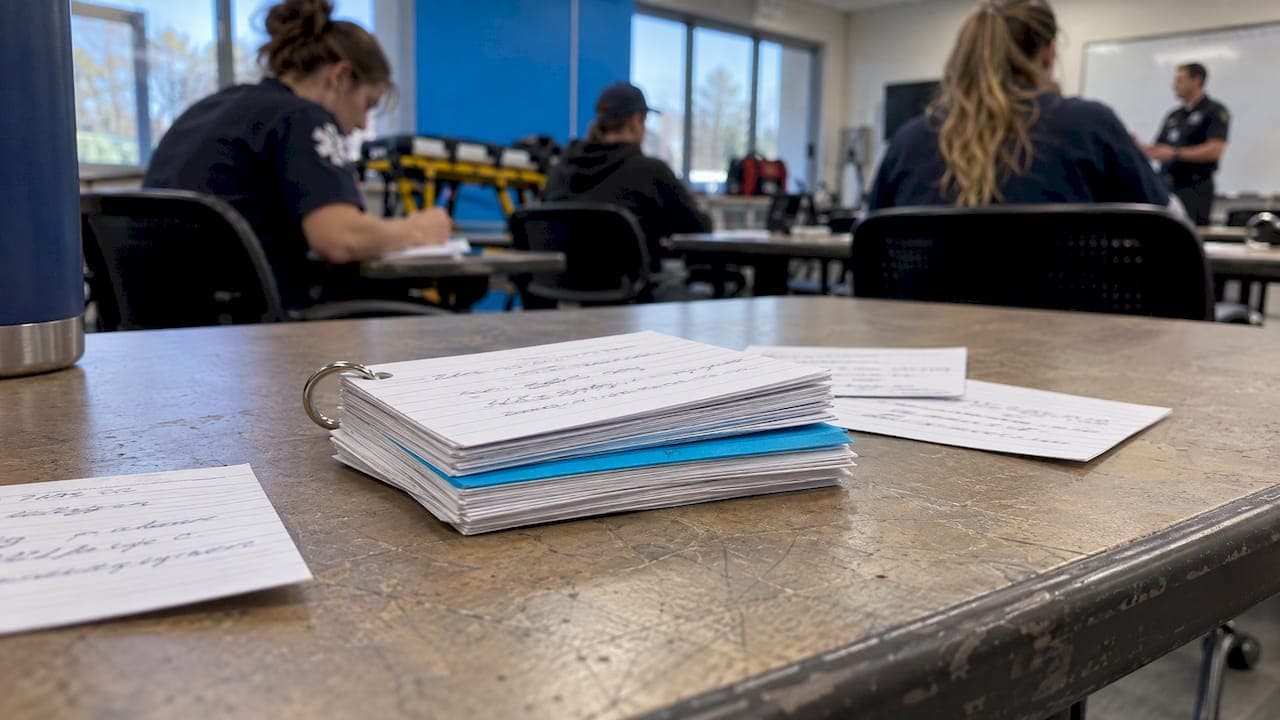
The best way to study EMT drug cards is to make each card answer the same few questions (what the drug is for, when not to give it, how it goes in, how much, and what you check afterward), then quiz yourself from memory every day instead of rereading. Cards work when they train recall and judgment. They fail when they become a list you recognize but cannot reproduce under pressure.
This guide covers what belongs on a card, which medications most EMT card sets include, a daily routine, and how to keep your cards accurate, because your state and medical director decide what you can actually give.
TL;DR
- Give every card the same fixed fields: class, indications, contraindications, route, dose, effects, and what to reassess.
- Start with the handful of drugs EMTs commonly carry: oxygen, oral glucose, aspirin, nitroglycerin, albuterol, epinephrine, and naloxone.
- Study by recall, not rereading: cover the card, say the answer, then check it.
- Your state and medical director set your medication list and doses. Verify every card against your local protocols.
- Learn drugs by class and expected effect, so you can reason when a scenario changes.
Table of Contents
- What an EMT drug card should include
- Which medications belong in an EMT deck
- How to study the cards so you remember them
- Perspective: why most drug-card habits fail
- Keeping your cards current and accurate
- Build your own cards from your notes
- Where RecallOS fits
- FAQ
- Sources
What an EMT drug card should include
A useful card is short enough to flip in seconds and complete enough to prevent a dangerous gap. Public sets, such as the free state-based decks that rank for this search, vary a lot in layout. Build your own around the same fields every time.
Front of the card
- Generic name and common trade name (for example, albuterol and its brand names)
- Drug class or category
Back of the card
- Indications: the specific presentation, not just the diagnosis. "Chest pain of suspected cardiac origin" is more useful than "heart problems."
- Contraindications and cautions: allergies, low blood pressure, recent use of certain medications, altered mental status that prevents safe swallowing.
- Route: oral, sublingual, inhaled, intranasal, intramuscular, and the device involved.
- Adult and pediatric dose: copied from your protocol, with the protocol version noted.
- Expected effects and side effects: what you should see, and what should worry you.
- Reassessment: which vital signs or findings you recheck, and when.
The rights of medication administration are a good checklist for the layout. National instructional guidelines expect students to understand the rights of administration: right patient, right medication, right route, right dose, and right time. If a card does not let you rehearse each of those, it is missing a field.
Keep pediatric information on its own line
Pediatric dosing is where students lose points and where real errors happen. The national guidelines call for extra attention to dose calculations, dilutions, and pharmacokinetic differences in children. Give pediatric doses their own labeled line on every card so you cannot skim past them.
Which medications belong in an EMT deck
No single national list applies everywhere. The national scope of practice model gives guidance, but each state determines the scope of practice of its licensed EMS personnel. Still, the same core drugs show up again and again. A national EMS overview notes that EMTs may administer nitroglycerin, glucose, epinephrine, and albuterol in special circumstances.
State lists show how this plays out. West Virginia's EMT scope page, for example, lists activated charcoal, albuterol, aspirin, epinephrine 1:1,000 by auto-injector or vial, nitroglycerin, oral glucose gel, oxygen, and acetaminophen. Wyoming's interpretation document covers oral glucose and aspirin with medical direction approval, and naloxone by unit-dose auto-injector or premeasured nasal spray for EMTs, and notes that EMTs may give nitroglycerin only when it is prescribed to the patient and ordered by medical control. Two states, two different lists with real differences.
A practical starter deck:
| Drug | Typical use | One thing to burn in |
|---|---|---|
| Oxygen | Hypoxia | Treat the patient's oxygenation, not a habit |
| Oral glucose | Hypoglycemia | The patient must be awake and able to swallow |
| Aspirin | Suspected cardiac chest pain | Ask about allergy and active bleeding |
| Nitroglycerin | Cardiac chest pain | Check blood pressure before and after |
| Albuterol | Wheezing, bronchospasm | Watch heart rate and tremor |
| Epinephrine | Anaphylaxis | Know your route and device |
| Naloxone | Suspected opioid overdose | Support ventilation first |
The last column is a study prompt, not a protocol. Your cards should hold your own local dose and order language.
Add drugs only if your state and agency allow them, plus any your course instructor assigns. A 10-card deck you know cold beats a 60-card deck you half know.
How to study the cards so you remember them
Use active recall, not rereading
Looking at a card feels productive and teaches little. Cover the back, say the indications, contraindications, route, and dose out loud, then flip and score yourself. Cards you miss go back into the pile sooner. If you want the memory science and mnemonic strategies behind this, our guide to pharmacology memorization techniques walks through them.

Learn by class and effect
Professional guidance from NAEMT's membership publication argues that providers should be taught pharmacology by drug class and expected effects rather than a static list, which builds the critical thinking to assess a patient when the usual drug is not available. On your cards, add one line: "What should this do to the patient, and how will I know?" Once you understand that a bronchodilator should ease work of breathing and may raise heart rate, the side effects stop being trivia. The nursing-side primer on pharmacology suffixes and drug classes shows the same class-first habit.
Run a daily loop
A simple routine that fits around class and shifts:
- Morning, 10 minutes: Flip through new and missed cards with the backs covered.
- Midday, 5 minutes: Pick two drugs and say the full rights of administration for each, out loud.
- Evening, 10 minutes: Work one scenario. A patient with chest pain and a low blood pressure reading: which cards apply, and which drug do you hold?
- Weekly: Sort cards into know, shaky, and missed. Spend most of the week on shaky and missed.
Scenarios matter because the exam and the street rarely ask "what is aspirin?" They ask what you do for this patient. Practice with NREMT scenario-based questions once the basics are solid.
Practice the physical steps too
Education standards stress that pharmacology competency should go beyond lectures to include psychomotor simulation and ongoing competency verification. Use your cards in skills lab: read the card, then perform the cross-check aloud with a partner. The standards also highlight formal cross-check procedures as a core part of medication safety. Intramuscular administration was added to the EMT scope in the national model's 2021 change notices, so drawing medication from a vial is a skill worth rehearsing, not just a card to read.

Perspective: why most drug-card habits fail
We build study tools with practicing nurses and CRNAs, and the same pattern shows up in every healthcare exam track: students collect cards, then never test themselves on the weak ones. The deck gets bigger, the recall does not.
Three habits fix most of it. First, fewer cards with consistent fields. Second, daily short sessions instead of weekend marathons, because retrieval spaced over days is what makes a dose stay put. Third, always tie a drug to a patient presentation, so the card trains a decision rather than a definition.
The other trap is trusting someone else's deck blindly. A card made years ago for another state can be wrong for yours, and it will look just as confident. Treat every card as a draft until you check it against your own protocol.
— Caleb
Keeping your cards current and accurate
This is the step most students skip. Education standards advise students to update drug information based on the most recent local protocol revisions rather than relying only on static or commercial materials. Here is how to do it:
- Write the source on the card. Add "Protocol, county or state, version" in small print on the back.
- Get the current protocol book. Your instructor, agency, or state EMS office publishes it. Do not copy doses from a random deck or an old screenshot.
- Check scope. If a drug is on a purchased set but not on your state's EMT list, put it in a separate "not in my scope" pile.
- Recheck each term and each time protocols change. Ask your instructor how updates are announced.
- Flag conflicts. If your card, textbook, and protocol disagree, ask your instructor or medical director. The protocol your medical director signed wins.
This matters for the exam too. The NREMT tests national standards, while your day-to-day practice follows local medical direction. Know both, and label which is which. Our paramedic exam study guide for NREMT candidates covers how the exam side fits together.
Build your own cards from your notes
Store-bought sets are a decent start, but cards you make force you to process the material. Take your lecture notes and protocol pages, and pull out one drug per card using the fields above. If you want to speed that up, see how to make flashcards from notes in about 15 minutes, or how to turn PDFs into flashcards and check them before you trust them.
Once you have cards, tie them to the rest of your skills. Airway steps and drug decisions often arrive in the same scenario, so pair your deck with the EMT airway management steps, and practice reading a patient with a 90-second trauma assessment.
Where RecallOS fits
Paper cards are good for the first pass. The hard part is the daily follow-through: knowing which drugs you keep missing and seeing them again at the right time. RecallOS is a study app built by practicing nurses and CRNAs around daily high-yield practice, personalized review of weak areas, instant rationales, and streaks. It supports EMT and other certification exams, and you can upload your own notes to generate flashcards, quizzes, and summaries from your material. Start with the Daily Recall Run for a short daily session, or upload your notes and turn your protocol summaries into practice. See the plans at recallos.co.

Whatever you use, check doses against your local protocol. The app helps you retrieve and review; your medical director's protocol is the authority on what you give.
FAQ
How many drug cards does an EMT student need?
Start with the drugs your state allows EMTs to give and your instructor assigns, often fewer than ten. Master those with all fields filled in before adding anything else. Your state's EMT medication list is the right boundary.
Should I use a premade deck or make my own?
Both can work. A premade deck saves time, but it may reflect another state's protocols or an outdated version. Making your own from your course notes and current protocols forces you to process the material, and you know the source of every dose.
Are the doses on online EMT drug cards reliable?
Treat them as a starting point only. Education standards advise updating drug information from the most recent local protocol revisions. Compare each dose to your current protocol book and ask your instructor if anything differs.
What is the best way to memorize contraindications?
Pair each contraindication with a patient picture, such as low blood pressure before nitroglycerin, and say it aloud in a scenario. Retrieval from a story is easier than retrieval from a bare list. Quiz yourself on contraindications separately from indications.
Do EMT medications differ by state?
Yes. The national model offers guidance, but each state sets scope of practice, and medical direction sets the protocols. West Virginia and Wyoming list somewhat different EMT medications, so confirm your own state's list.
Sources
- National EMS Education Standards: Advanced EMT Instructional Guidelines (ems.gov)
- EMS Education Standards, 2021, amended February 24, 2025 (ems.gov)
- National EMS Scope of Practice Model 2019 with change notices (NREMT)
- EMS Overview (NAEMT)
- NAEMT News, Spring 2020
- EMT Scope of Practice (West Virginia Department of Health)
- Wyoming Scope of Practice Interpretation Document