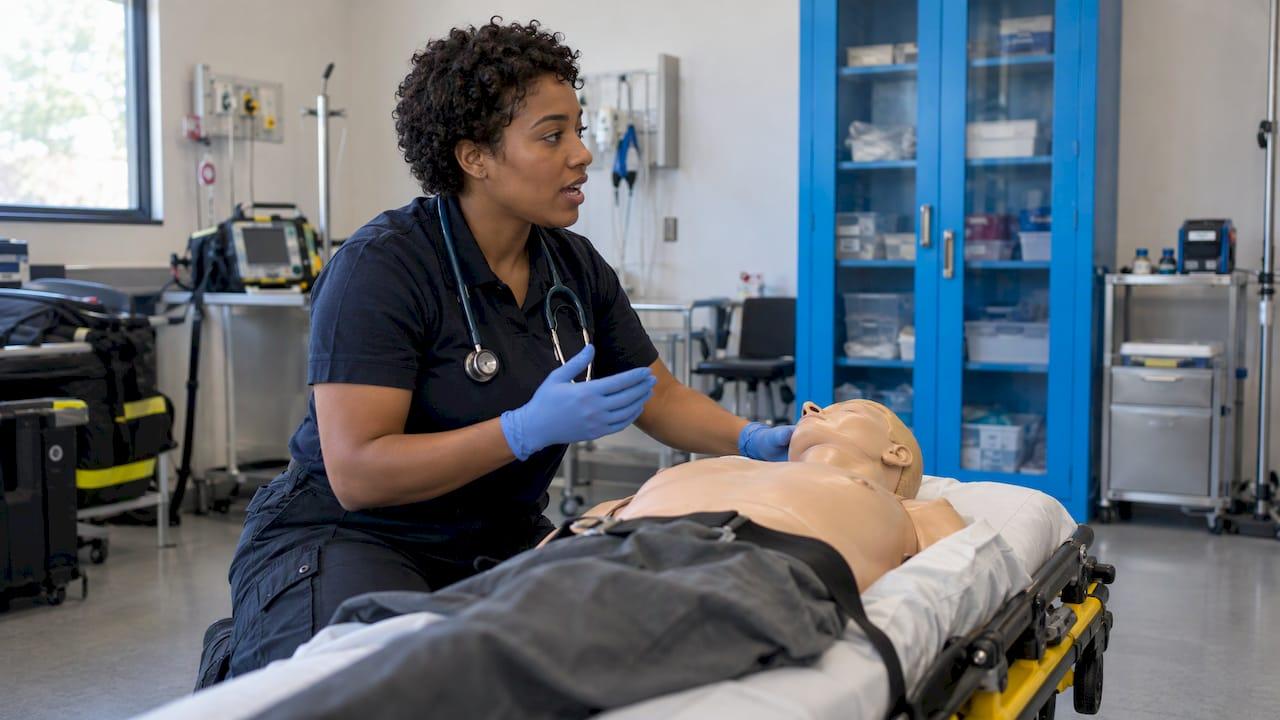
The fastest way to prepare for NREMT scenarios is to rehearse one fixed assessment sequence out loud, learn the critical failures that end a station, and then test yourself daily on short cases until the sequence stays automatic under pressure. Reading a protocol once does not do that. Retrieval practice does: you pull the steps out of memory, get the rationale right away, and come back to what you missed. That is how we built RecallOS, and its daily high-yield questions and weak-area review support EMT exam prep alongside nursing and other healthcare exams.
This guide covers what "scenario" means at each certification level, the sequence to run, how stations are scored, what to drill by exam domain, and a practice routine you can start today.
TL;DR
- At the EMT level, scenarios mean hands-on patient assessment stations. At the AEMT and Paramedic levels, the National Registry now uses scenario-based exam items that follow a call from en route to post-scene.
- Run the same order every time: scene size-up, primary assessment, secondary assessment, treatment and transport.
- Critical failures, such as skipping PPE, missing scene safety or doing the secondary exam before treating ABC threats, fail a medical station no matter how many points you earn elsewhere.
- Clinical Judgment is the largest domain on both ALS exams, so practice deciding, not just recalling.
- Short daily retrieval sessions with instant rationales beat long weekend cram blocks for keeping the sequence automatic.
Table of Contents
- What "scenario" means on the NREMT
- The sequence to run every time
- How scenarios are scored, and what fails you
- What to drill, by exam domain
- A practice routine that builds recall and judgment
- Why progressive practice matches how programs now assess
- Perspective
- Start your daily scenario practice
- FAQ
- Sources
What "scenario" means on the NREMT
The word covers two different things, and which one applies depends on your level.
EMR and EMT candidates. The National Registry made no changes to EMR and EMT eligibility or exam requirements in its ALS redesign resolution. For EMTs, scenario prep still means getting ready for hands-on stations where an evaluator watches you manage a simulated patient. States run these practical exams. Connecticut's EMT psychomotor exam manual is a clear example. It lists five stations: trauma patient assessment (10-minute maximum), medical patient assessment (15-minute maximum), bag-valve-mask ventilation of an apneic adult (5-minute maximum), cardiac arrest management with AED including two minutes of one-person CPR (5-minute maximum), and one random EMT skill. Your state's requirements may differ, so confirm the station list with your program director or state EMS office.
AEMT and Paramedic candidates. The National Registry began offering new AEMT and Paramedic examinations on July 1, 2024, discontinued the ALS cognitive exams that day, and directed that ALS psychomotor exams be discontinued by July 1, 2025, according to the same board resolution. The scenario now lives on the screen. The Registry's announcement of scenario-based items says these items present the three components of clinical judgment: en route, scene, and post-scene. It described at least one scenario of 9 to 18 items for AEMT and more than one scenario of up to 10 items for Paramedic.

So the skill is the same across levels: think through a call in order and make the right decision at each point. Only the format changes, from a person in front of you to a question stem on a screen.
The sequence to run every time
A scenario is easier when you never have to decide what comes next. The National Registry's EMT Test Plan organizes the job around these tasks, and they make a good scaffold for any medical call:
- Scene size-up and safety. Protect yourself and others, put on PPE, think about triage, and request additional resources.
- Primary assessment. Build rapport, check level of consciousness, airway, breathing and circulation, identify the chief complaint and life threats, take baseline vitals, and make a rapid treatment and transport decision.
- Secondary assessment. History, a focused or full physical exam, and repeat vitals.
- Patient treatment and transport. Treat what you found, reassess, and hand off.
Say each step aloud as you practice, including the "boring" ones. Evaluators and exam items reward a candidate who states PPE and scene safety before touching the patient. If you rehearse silently, you tend to skip them when nerves hit.
Where the history fits
The Registry's medical assessment sheet scores history taking with specific mnemonics. According to the E202 medical patient assessment sheet, OPQRST is worth 8 points plus 2 clarifying questions, and SAMPLE is worth 5 points. Memorize both as sentences you can say, not as letters you hope to unpack. The sheet dates from 2016, so use it to understand how a medical assessment is built and check your program for the current version.
How scenarios are scored, and what fails you
The E202 sheet awards 42 points across scene size-up, primary survey and resuscitation, history, secondary assessment, vital signs, field impression, interventions, and reassessment. Points alone do not decide the outcome, though. The same sheet lists critical criteria that fail the station, including:
- Failing to take PPE precautions
- Failing to determine scene safety before approaching the patient
- Inadequate oxygen therapy or ventilation
- Failing to manage airway, breathing, hemorrhage or shock problems
- Performing the secondary exam before treating ABC threats
- Ordering a dangerous or inappropriate intervention
- Giving an inaccurate report to the arriving EMS unit
Notice the pattern. Most of these are sequence errors, not knowledge gaps. A candidate who knows everything about chest pain can still fail by going to the history before fixing an airway problem. That is why scenario prep is about order and priorities first and facts second.
Connecticut's manual adds a practical point: evaluators do not discuss specific errors with candidates during the exam. You will not get a hint mid-station, so your self-correction has to be built in beforehand.
For on-screen ALS items, the Paramedic Test Plan (effective July 1, 2024) lists multiple-choice, multiple-response, build list, drag-and-drop, options box, graphical and scenario-based items. All are scored dichotomously: full credit only for a correct response, no partial credit. In a multiple-response or build-list item, getting most of it right still earns nothing, so practice finishing the whole list.
What to drill, by exam domain
The National Registry's AEMT and Paramedic examinations page publishes the content weights, with pediatric care integrated throughout:
| Domain | AEMT | Paramedic |
|---|---|---|
| Airway, Respiration & Ventilation | 9–13% | 8–12% |
| Cardiology & Resuscitation | 11–15% | 10–14% |
| Trauma | 7–11% | 6–10% |
| Medical/Ob/Gyn | 25–29% | 24–28% |
| EMS Operations | 6–10% | 8–12% |
| Clinical Judgment | 31–35% | 34–38% |
Two takeaways for your study time. First, Clinical Judgment and Medical/Ob/Gyn together make up more than half of each ALS exam, so most of your scenarios should be medical calls where you must prioritize. Second, pediatrics is not a separate unit to cram at the end. It shows up inside every domain, so write pediatric versions of your adult scenarios. If infant choking is a weak spot, a refresher on infant choking response steps gives you a clear back-blow and chest-thrust sequence to rehearse.
For EMT candidates, the four skill areas that recur across state practical exams are trauma assessment, medical assessment, airway and ventilation, and cardiac arrest with AED. Our guides on trauma assessment steps and OPA and NPA airway management break each into short sequences you can drill.

A practice routine that builds recall and judgment
Here is the routine, step by step, with where it usually goes wrong.
Step 1: Write your sequence on one page
Copy the four-part sequence above, add OPQRST and SAMPLE, and add your critical failures list. This is your template. The usual mistake is collecting five different checklists from five sources and blending them. Pick one and stick with it.
Step 2: Turn your notes into questions
Passive rereading feels productive and builds little. Convert each skill into prompts: "What do I do right after confirming scene safety?" "Which findings change my transport decision?" In RecallOS, the Upload Notes feature generates flashcards, quizzes and summaries from the notes and materials you upload, so your class handouts become retrieval practice without hours of card writing. You can try it from the Upload Notes page.
Step 3: Talk through a scenario out loud
Pick a short case, such as a 58-year-old with chest pain and diaphoresis, and narrate from PPE to handoff. Time yourself against the station limits: 10 minutes for trauma and 15 for medical in the Connecticut format. The common error is stopping when you feel "done" without giving the report. The E202 sheet fails an inaccurate report to the arriving unit, so finish with a spoken handoff.
Step 4: Add one twist each round
Change one variable: the patient becomes unresponsive, the scene becomes unsafe, vitals worsen. This trains the en route, scene and post-scene thinking the ALS scenario items test. It also exposes whether you are following a script or actually prioritizing.
Step 5: Review misses within a day
A wrong answer is useful only if you see it again. Keep a short miss list and revisit it the next day, then a few days later. RecallOS gives instant rationales and builds personalized review of your weak areas, so the questions you missed return without you having to track them by hand.
Step 6: Make it daily and short
Ten to twenty minutes every day holds the sequence in memory better than one long session each weekend. The Daily Recall Run is built for this habit, with streaks and rewards to keep you showing up and peer challenges if you like studying with classmates. See how it works on the Daily Recall Run page. If you are planning backward from an exam date, our NREMT study plan lays out 4-, 8- and 12-week schedules, and our guide to scenario-based NREMT questions goes deeper on the question format.
Step 7: Practice the medication piece separately
Scenarios often turn on a drug decision. Study indications, doses and contraindications as short cards and test them cold. Our guide on studying EMT drug cards shows how to make them stick. Paramedic candidates can pair it with our paramedic exam study guide.
Why progressive practice matches how programs now assess
Program-level assessment is moving the same way. After the late-2022 ALS redesign removed the traditional AEMT and paramedic psychomotor assessment, New Hampshire's portfolio-based final practical uses minimum competencies, formative and summative scenarios, and a terminal competency document. Its stated rationale is a more complete picture of performance over a whole course instead of one moment in time, built through practice events and scenarios that resemble real EMS work. For you, that means repeated, varied scenario practice over weeks is what both the field and the assessors reward. A single cram session does not.
Vermont's adoption of the NASEMSO guideline points the same direction. It requires at least 20 live patient exposures for AEMT students, as the Vermont-adopted AEMT competency guideline states, and from July 1, 2024 the National Registry requires the program director to verify minimum competency. Your lab and clinical time is the hands-on layer. Daily retrieval practice is what keeps the sequence sharp between those sessions.
Perspective
Most candidates we talk about in this space do not fail for lack of effort. They fail because the sequence was never made automatic, and because their review was random. Reading a chapter on chest pain and then doing 50 unrelated questions feels like studying, but it does not train the habit of doing the right thing first.
RecallOS was built by practicing nurses and CRNAs who know what it means to prioritize under pressure, and our content is aligned to real exam blueprints. We believe in high-yield questions over trivia, instant rationales so a mistake teaches you something in the moment, and personalized review that brings your weak areas back until they stop being weak.
For scenario prep, that means short daily runs where you retrieve the order of operations, see why an answer was right, and get the misses back later. Add your own class notes through Upload Notes and the material you practice is the material your instructors taught. Consistency wins this exam, and streaks, rewards and peer challenges exist to make consistency easier.
Caleb
Start your daily scenario practice
If you want a routine that keeps the assessment sequence fresh, RecallOS pairs daily high-yield practice with personalized review of your weak areas. It supports EMT and other certification exams, and it can turn your own notes into flashcards, quizzes and summaries. Start with the daily free set or a plan like Recall+ or Recall Pro at RecallOS.

Plans are sold through Apple In-App Purchase, and the subscription terms explain how billing works.
FAQ
Does the NREMT still have a hands-on exam?
For EMR and EMT candidates, the National Registry made no changes to eligibility or exam requirements, and states continue to run practical stations. For AEMT and Paramedic, the ALS psychomotor exams were directed to be discontinued by July 1, 2025, and the new ALS performance exams began July 1, 2024. Ask your program director which version applies to you.
How long do medical and trauma stations last?
In Connecticut's EMT format, the trauma patient assessment has a 10-minute maximum and the medical patient assessment has a 15-minute maximum. Cardiac arrest with AED and BVM ventilation each have 5-minute maximums. Practice with a timer at those limits, and check your own state's manual for its times.
What fails a medical scenario even if my score is high?
Critical criteria on the Registry's E202 sheet fail the station on their own. Examples include skipping PPE, not confirming scene safety, doing the secondary exam before treating ABC threats, inadequate oxygen or ventilation, a dangerous intervention, or an inaccurate report to the arriving unit. Rehearse these as rules you never break.
What should I study most for the ALS scenario items?
Clinical Judgment carries the most weight: 31 to 35 percent of the AEMT exam and 34 to 38 percent of the Paramedic exam. Medical/Ob/Gyn is next at about a quarter of each. Build practice cases around prioritizing and decision-making in medical calls, with pediatric versions mixed in.
Sources
- National Registry resolution on ALS redesign implementation dates
- Connecticut DPH EMT Psychomotor Exam Manual
- National Registry announcement on scenario-based items
- National Registry EMT Test Plan
- E202 medical patient assessment sheet
- National Registry Paramedic Test Plan
- National Registry AEMT and Paramedic examinations page
- New Hampshire portfolio-based assessment packet
- NASEMSO AEMT Student Minimum Competency guideline (Vermont)