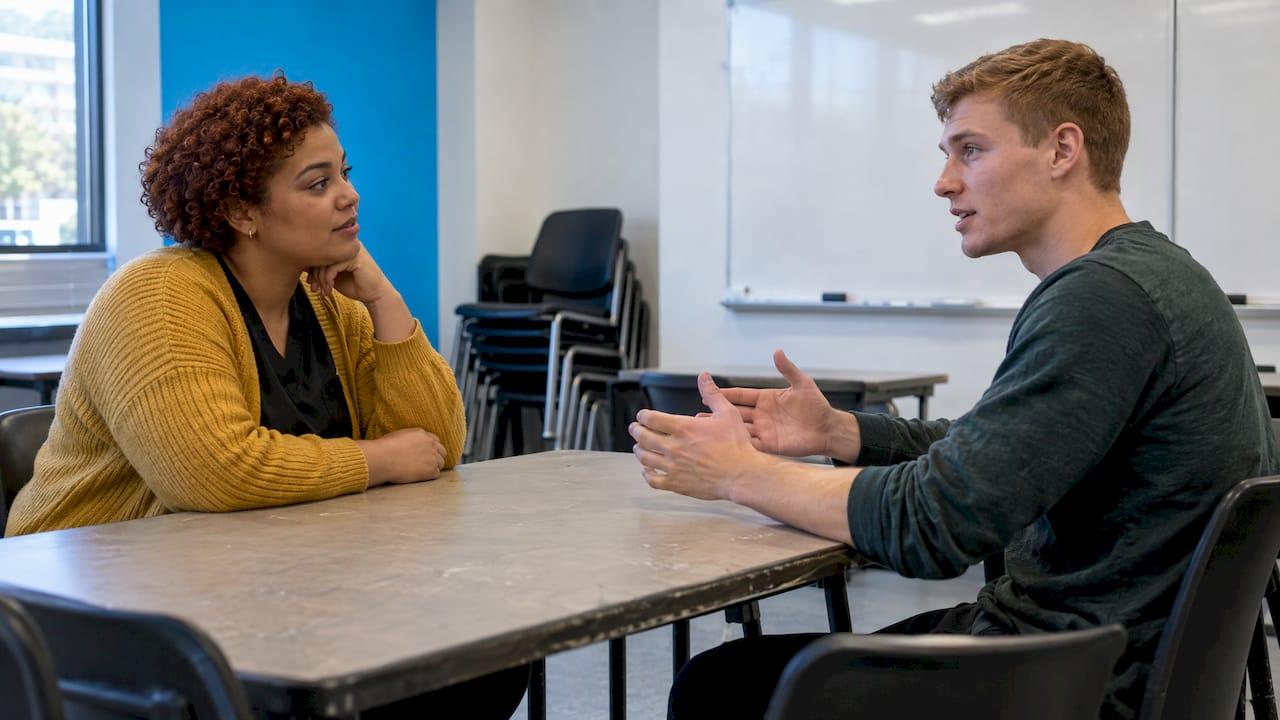
Retrieval practice means pulling information out of your memory, with practice questions, blank-page recall or closed-book quizzing, instead of looking at your notes again. For nursing students it is one of the best-supported ways to study, and it fits the NCLEX well because that exam asks you to apply what you know, not just recognize it. This guide explains what it is, what the evidence says, and how to build it into a weekly routine.
TL;DR
- Retrieval practice is actively recalling information from memory. Rereading is passive review, and retrieval practice improves long-term memory and understanding compared with it.
- Spread it out. Several spaced retrievals beat one cram session for long-term retention.
- Match the format to the exam. For the NCLEX, applied practice questions with rationales are the closest match.
- A wrong answer still helps when you check the correct one right away.
- A small daily set you actually finish beats a long session you keep postponing.
Table of Contents
- What retrieval practice is, and what it is not
- What the research shows for health professions students
- Why it feels harder than rereading (and why that is fine)
- Choose the right type of recall
- Build a retrieval routine in six steps
- Practice the way the NCLEX tests
- What to do with wrong answers
- Tailor it to your exam
- Retrieval after a hard lecture
- Put retrieval practice on autopilot with RecallOS
- FAQ
- Sources
What retrieval practice is, and what it is not
Carnegie Mellon's teaching center describes quizzes, flashcards, practice problems and exams as forms of retrieval practice, while rereading counts as passive review. The difference is the work your brain does. Retrieval brings information from long-term memory into working memory, and that effort strengthens the memory pathway.
Here is how that looks on an ordinary study night:
| Passive review | Retrieval practice |
|---|---|
| Rereading your cardiac chapter | Writing everything you remember about heart failure on a blank page, then checking it |
| Highlighting a pharmacology table | Covering the table and reciting each drug's class, action and key nursing consideration |
| Watching a lecture recording again | Answering ten questions on the topic before you open the recording |
| Copying notes neatly | Turning your notes into questions and answering them tomorrow |
None of the passive habits are useless for a first pass through new material. The point is that once you have seen the material, the next hour is better spent trying to recall it.
What the research shows for health professions students
The evidence base is large. A 2023 systematic review of health-professions education covered 56 studies and 63 experiments. In it, 43 experiments showed significant benefits of distributed practice and/or retrieval practice over control or comparison groups. The authors concluded both strategies are effective for improving academic grades, and they noted that the interventions, assessments and study quality varied.
A 2025 state-of-the-art review by Serra and colleagues reports robust evidence that retrieval practice strengthens memory and comprehension in health-professions education, including nursing and licensing-exam preparation.
Timing matters too. A medical-education review by Yang, Razo and Persky found that testing beats restudy for long-term retention, and that the benefit grows with the delay: an effect size of 0.58 for intervals under one day versus 0.78 for longer intervals. In plain terms, the longer you have to remember something, the more retrieval practice pays off. That is good news if your exam is weeks away.

Nursing education has its own body of work. A 2024 Journal of Nursing Education review screened 2,000 titles and included 51 studies. It found that testing, spaced learning, educational technology, case-based learning and concept mapping were generally effective, with no single strategy shown to be superior. The practical reading: retrieval works best as the backbone of a mix, combined with spacing and case-based thinking.
Students already lean this way. In a 2025 study of 83 undergraduate nursing students, every participant used at least one retrieval strategy, and 92% quizzed aloud with a partner. The opportunity is to make that habit more deliberate and more regular.
Why it feels harder than rereading (and why that is fine)
Retrieval practice feels slower and more uncomfortable than rereading. You stall, you guess, you get things wrong. Rereading feels smooth because the answer is sitting right there.
Yang, Razo and Persky describe this as a desirable difficulty: restudy may look better immediately, but testing is more likely to preserve access to knowledge over longer delays. If a quiz feels harder than a reread, that is the effort doing its job. Do not judge your progress by how fluent a chapter feels the day you read it. Judge it by what you can produce a week later.
Choose the right type of recall
Not all retrieval demands the same effort. The 2023 review separates three types: recognition (such as multiple choice) is the least demanding, cued recall (fill-in-the-blank or short answer) is harder, and free recall is the most demanding.
| Type | Example for a nursing student | Best used for |
|---|---|---|
| Recognition | NCLEX-style multiple-choice or select-all questions | Applying knowledge under exam conditions |
| Cued recall | "The antidote for heparin is ___" or a short-answer prompt | Locking down facts you keep missing |
| Free recall | A blank-page brain dump of everything about DKA | Building the big picture before you test the details |
A good sequence for one topic: free recall first to find the holes, cued recall to patch them, then recognition-style questions to practice applying it all. If you want to see how this plays out for one of the heaviest NCLEX content areas, our guide to pathophysiology study strategies walks through it. For drug content, pharmacology memorization techniques show how to turn class tables into recall prompts.
Build a retrieval routine in six steps
- Learn it once, briefly. Read or attend the lecture, then stop reading.
- Recall the same day. Close everything and write or say what you remember. Check it against your notes and mark the gaps.
- Turn the gaps into questions. Each missed point becomes a question or a card, not a highlighted line.
- Space the repeats. Yang and colleagues note that a commonly proposed spacing interval is 10% to 20% of the time you want to remember the material. If your exam is 60 days away, that suggests revisiting a topic roughly every 6 to 12 days, with shorter gaps right after you first learn it.
- Mix topics. Once you have covered a few systems, answer questions from several at once, the way the exam will.
- Review the weak list first. Start each session with the questions you missed last time.
The same research stresses the broader principle: multiple retrievals spaced over time outperform a single massed test, and spaced practice can produce better long-term retention even when cramming looks as good in the short term. If you want a ready-made calendar, our 30-day study challenge plan lays out the daily structure, and study retention techniques that work for nursing exams covers the habits around it.
Practice the way the NCLEX tests
The NCLEX is built on clinical judgment: reading a case, spotting the cues, deciding what matters most and acting. Serra and colleagues recommend what they call transfer-appropriate retrieval: practice should resemble the cognitive processing the target exam requires. They point out that flashcards promote repeated exposure to discrete facts, while licensing exams use case-based vignettes that call for applied reasoning. So the best plan uses both: cards to lock in the facts, and applied questions to make you use them.
Elsevier's nursing-education guide adds a useful twist. It suggests varying question formats with case studies, rationale discussions and altered "what-if" scenarios, so you retrieve content, analyze cues and practice nurse-like decisions instead of just counting questions.
In practice, after every question, ask yourself three things:
- Why is the right answer right?
- What would make each wrong option right? (Change the patient's age, lab value or setting and see what shifts.)
- Which cue in the stem should have pointed me there?
That habit turns a 90-second question into five minutes of real retrieval. For the newer item types, our six-step NGN case strategy shows how to work through a case, and training clinical judgment instead of memorization covers the broader test-taking approach.
What to do with wrong answers
Missed questions are the most valuable material you have. Carnegie Mellon explains that even an incorrect retrieval attempt can support learning when you get feedback that identifies the correct answer. So guess first, then check. Do not skip the attempt because you are unsure.
The 2023 review found that evidence on feedback specifically is mixed, so keep your own system simple and consistent:
- Read the rationale straight after you answer, while the attempt is fresh.
- Write the correct reasoning in one sentence, in your own words.
- Put the question back into your rotation a day or two later, then a week later.
- Track the topics you miss repeatedly. Those are your real study guide.
The same review also noted that retrieval questions identical to the assessment may be more effective than non-identical ones. That is a reason to re-answer your missed questions, not only to read about the topic again.
Tailor it to your exam
The principle is the same for everyone: match your practice to the thinking the exam demands. The details change by stage.
Pre-nursing and TEAS or HESI prep. Your exam rewards solid foundations in science, math and reading. Cued recall and short mixed quizzes work well here. See TEAS and HESI exam prep strategies.
NCLEX candidates. Lean toward applied, case-style questions with rationales, mixed across content areas, plus a daily set of missed items.
CRNA and SRNA candidates. Heavy pharmacology, physiology and anesthesia concepts reward free recall followed by mixed practice. Our CRNA exam prep tips explain why daily mixed practice matters.
EMT and paramedic students. Scenario-based prompts are the closest match to what you will face, as in our guide to NREMT scenario-based questions.

Retrieval after a hard lecture
Sometimes retrieval fails because you never understood the material in the first place. You cannot recall what you did not follow. If a lecture left you lost, get it explained before you quiz yourself. One option is to turn lecture slides into step-by-step lessons that are explained out loud, then close the tab and run your recall on the same topic. Understand first, retrieve second, repeat on a schedule.
Our perspective
We built RecallOS around one belief: the problem for most nursing students is not a lack of material, it is a lack of daily retrieval. Students tell us they have read the chapter three times and still freeze on the question. Rereading feels productive, but it is not the same as pulling an answer out of your head.
That is why our practice is designed around small daily sets of high-yield questions written by practicing nurses and CRNAs and aligned to real exam blueprints. We want you answering questions that look like the ones on the exam, not random trivia. Instant rationales close the loop on every miss, and personalized review brings your weak areas back until they stop being weak.
We also believe consistency beats intensity. Streaks, rewards and peer challenges are there for one reason: to get you to show up tomorrow, and the day after. Retrieval only works if it is repeated, and habits are what make it repeat.
Caleb
Put retrieval practice on autopilot with RecallOS
The hard part of retrieval practice is not understanding it. It is doing it every day, with questions that match your exam and a way to bring back what you missed. That is what RecallOS is designed to do. The Daily Recall Run gives you a focused set of high-yield questions each day, and our NCLEX study app is built around exam-blueprint content with rationales.
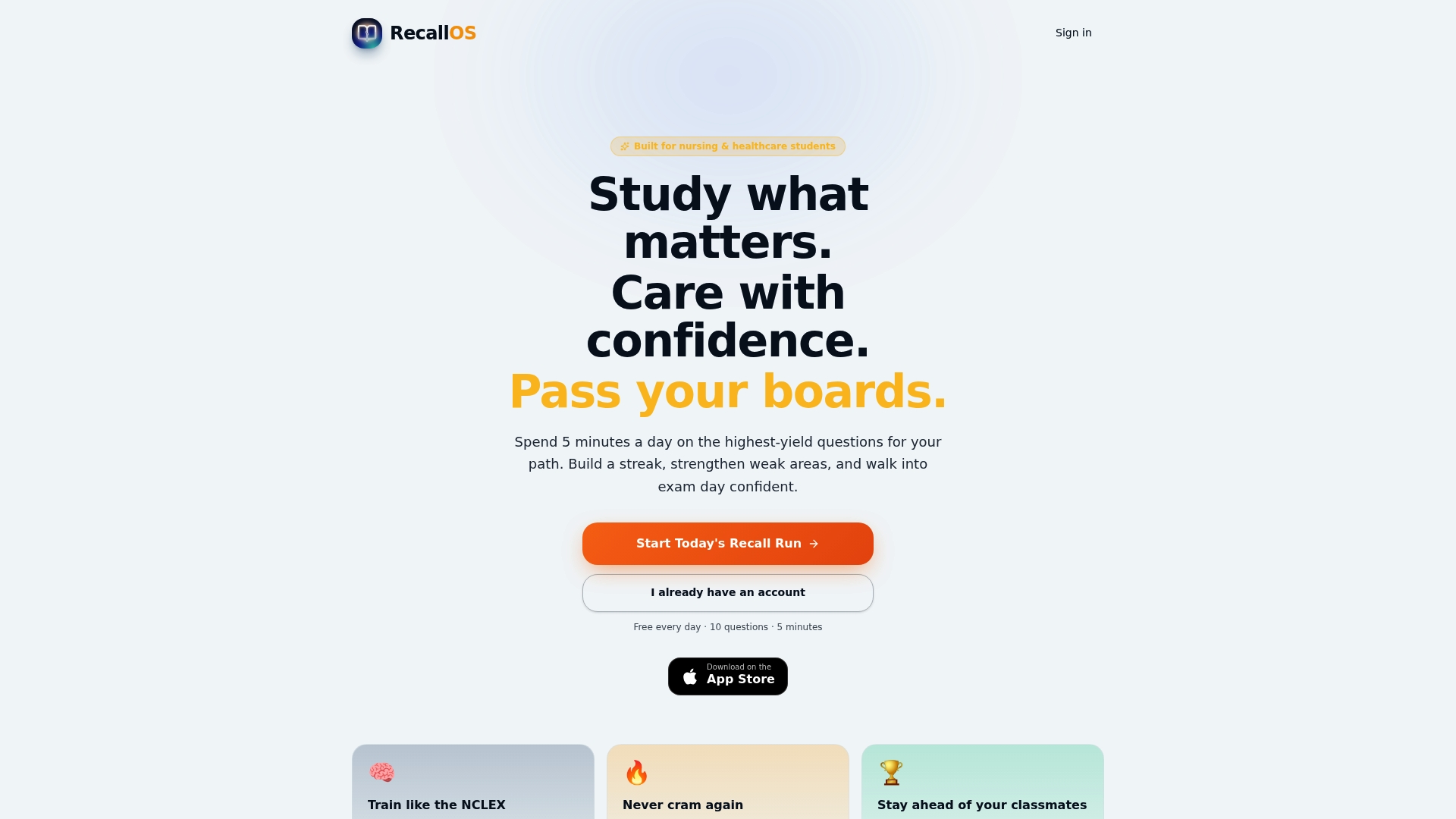
You can also use Upload Notes to generate flashcards, quizzes and summaries from your own class materials, so your retrieval practice follows your syllabus. If you are studying for a specialty exam, there are pages for the CCRN and CRNA and SRNA paths. See the plans on the RecallOS home page.
FAQ
Is retrieval practice the same as active recall?
They describe nearly the same thing. Both mean trying to bring information out of memory instead of looking at it again. Retrieval practice is the term used in most research, and active recall is the one students use more often.
How often should I practice retrieval for the NCLEX?
Short and regular beats long and rare. The research supports spreading retrievals over time, and a common guideline is a gap of 10% to 20% of the time until your exam. A daily set of questions plus a weekly review of your missed items is a realistic pattern for most students.
Are flashcards enough for nursing exams?
Flashcards are a good retrieval tool for facts such as lab values, drug classes and antidotes. Because the NCLEX uses case-based items that require applied reasoning, Serra and colleagues suggest practice questions may offer more relevant retrieval. Using cards for facts and questions for application covers both.
What if I get most questions wrong at first?
That is normal and useful. An incorrect attempt followed by the right answer still supports learning. Read the rationale, restate it in your own words, and see the question again within a few days.
Sources
- The Use of Retrieval Practice in the Health Professions: A State-of-the-Art Review (2025)
- Systematic review of distributed practice and retrieval practice in health professions education (2023)
- Using Testing as a Learning Tool (Yang, Razo, Persky, 2019)
- Retrieval Practice for Improved Learning, Carnegie Mellon Eberly Center
- Durable Learning Strategies in Nursing Education, Journal of Nursing Education (2024)
- The Effects of Retrieval Practice on Knowledge Acquisition, University of Northern Colorado dissertation (2025)
- Retrieval Learning: Harnessing the Power of Questions, Elsevier
- Boredprof, AI lecture tutoring