
The study retention techniques with the strongest evidence are retrieval practice (testing yourself), spacing your reviews over days and weeks, and interleaving topics. They share one trait: they feel harder than rereading, and they work better. A 2019 review of study strategies in nursing education puts practice testing and distributed practice among the high-utility strategies, and rates rereading, highlighting and summarization as low-utility. Below is how to use each one for NCLEX-style and certification exam content, with a sample week you can copy.
TL;DR
- Test yourself before you reread. Retrieval practice beats passive review for long-term memory, including for high-stakes licensing exams.
- Spread study over several days instead of cramming. Short, repeated sessions beat one long one.
- Mix topics (interleaving) and group related content into logical chunks.
- Explain, draw and write your own questions. Teaching a concept or sketching a pathway from memory exposes gaps fast.
- Feeling confident is not proof you know it. Check yourself with questions, not impressions.
Table of Contents
- Why rereading feels productive and isn't
- Technique 1: Retrieval practice (active recall)
- Technique 2: Spaced (distributed) practice
- Is the 1-3-5-7 rule backed by evidence?
- Technique 3: Interleaving
- Technique 4: Chunking and connecting ideas
- Technique 5: Explain it, draw it, quiz yourself
- Technique 6: Calibrate your confidence
- Technique 7: Make it a habit you can sustain
- Common mistakes to avoid
- Our perspective
- Put these techniques to work in RecallOS
- FAQ
- Sources
Why rereading feels productive and isn't
Most students default to rereading and highlighting. The text becomes familiar, familiarity feels like knowledge, and the session ends with a pleasant sense of progress. Roediger and McDermott note that students often believe rereading and blocked practice help retention, even though spacing and retrieval practice produce better long-term results.
A guide written for medical students makes a related point: subjective ratings of competence are often inaccurate, and methods that leave you feeling less competent tend to be associated with better long-term retention. If a method feels slightly uncomfortable, that is often the sign it is doing work.
Researchers think this is why good strategies are underused. Carpenter, Pan and Butler argue that students lack awareness of spacing and retrieval, and that these methods feel counter-intuitive next to easier, less effective habits. Knowing this is half the fix. The other half is a routine that makes the harder method the default.

Technique 1: Retrieval practice (active recall)
Retrieval practice means pulling information out of memory instead of putting it back in. A 2025 review of the health professions literature states that active recall strengthens memory and comprehension and is well supported by cognitive psychology for both course exams and high-stakes licensing exams.
The evidence in health education is broad. A BEME systematic review of test-enhanced learning found that interventions such as short-answer questions, multiple-choice questions, simulation and standardized patients improved 21 of 23 retention outcomes.
How to do it with nursing content
- Close the book first. After a lecture on heart failure, write everything you remember: signs of left- versus right-sided failure, first-line medication classes, key nursing priorities. Then check your notes and mark what you missed.
- Use questions that match your exam. The 2025 review notes that practice questions may be more useful when they match the processing your exam demands. For NCLEX candidates, that means application and prioritization questions, not definition flashcards alone. Our guide to training clinical judgment instead of memorization covers this in detail.
- Keep the stakes low. MIT's Teaching + Learning Lab recommends low-stakes retrieval such as 3-2-1 exercises or frequent quizzes, which reduce anxiety and put the focus on learning rather than grading.
Why does it work? One explanation from the research literature is that retrieval requires learners to retrieve, reinstate and update context representations, so each attempt reshapes the memory instead of just replaying it. For a deeper walk-through, see our page on active recall for nursing.
Technique 2: Spaced (distributed) practice
Spacing means returning to material across several sessions. Washington State University's College of Nursing advises students to break material into chunks and study over multiple days rather than cramming, which also helps avoid fatigue.
The research base is large. A systematic review found that 43 of 63 experiments showed significant benefits of distributed practice and/or retrieval practice compared with control groups. One explanation from the Australian Education Research Organisation: spacing raises the effort needed to retrieve information, which can activate more related ideas and create new routes back to the target.
A five-day plan you can copy
WSU's guide describes a plan that splits an 8-hour study load across five days and combines concept mapping with self-testing. Here is a version for a unit exam, using that structure as a starting point. Adjust the hours to your schedule.
| Day | Focus | Method |
|---|---|---|
| 1 | First pass through chunk A (for example, cardiac) | Concept map from memory, then check against notes |
| 2 | Chunk B (for example, respiratory) plus 10 minutes on chunk A | Practice questions on B, quick recall of A |
| 3 | Chunk C plus short reviews of A and B | Questions mixed across all three |
| 4 | Weak spots only | Redo missed questions, explain them aloud |
| 5 | Full mixed review | Timed question set, then a short error log |
The logic of grouping comes from nursing educators too. Leslie Jennings, RN, suggests logical chunks that keep all content on one topic together rather than splitting it by delivery method, so lecture slides, textbook pages and pharmacology tables for one condition sit in one study block.
For how much to space and when, our post on retention versus cramming and the spacing rule goes further.
Is the 1-3-5-7 rule backed by evidence?
The 1-3-5-7 rule says to review new material one day, three days, five days and seven days after learning it. It is a popular, easy-to-remember schedule. We could not find a clinical or classroom trial that tested these exact intervals against others, so treat the numbers as a convenient template, not a proven formula.
What is supported is the principle underneath: reviews separated by time beat reviews bunched together, and each review works best as a self-test instead of a reread. A 2-4-6-8 or every-other-day schedule would follow the same logic. Use 1-3-5-7 if it gets you to actually review. Then adjust:
- If you miss a question at a review, bring that item back sooner.
- If you get it right easily, stretch the gap.
- If your exam is eight days away, compress the schedule to fit instead of abandoning it.
The habit matters more than the digits.
Technique 3: Interleaving
Interleaving mixes different topics within a session instead of finishing one before starting the next. The medical student guide describes it as unpopular with students yet shown to be effective, and notes it can improve learning through comparison.
This suits healthcare content well, because real exam questions rarely announce the topic. You might see a patient with shortness of breath and have to separate heart failure, COPD exacerbation, pulmonary embolism and anxiety. Practicing them together trains the discrimination you will need.
Practical ways to interleave:
- Finish a block on one system, then do a question set that mixes it with two earlier systems.
- Study similar drug classes side by side (for example, compare adverse effects and monitoring) instead of one at a time. Our pharmacology memorization techniques post shows how.
- When you review missed questions, shuffle them rather than reviewing in the order you took them.
Expect it to feel messier. The same guide also says spaced retrieval can reinforce schema formation by solidifying the framework you are building, which is what you need for pathophysiology. See pathophysiology study strategies that actually work for more.
Technique 4: Chunking and connecting ideas
A 2024 state-of-the-evidence review in the Journal of Nursing Education identified flipped classrooms, educational technology, spaced learning, team-based learning, concept mapping and case studies as effective classroom-based strategies. Two of those, concept mapping and case studies, are about connection.
Try this: pick one patient condition and build a single page that links cause, pathophysiology, assessment findings, labs, treatments, nursing priorities and complications. Draw it from memory, then fix it. Connected knowledge is easier to retrieve than isolated facts, and it is closer to how exam questions are written.
Technique 5: Explain it, draw it, quiz yourself
WSU's guide recommends that nursing students teach content to someone, draw figures from memory, and create practice problems or exams for themselves or with friends. MIT's teaching lab adds that retrieval practice such as posing concept questions improves long-term retention and the ability to apply information in new contexts.
A few ways to do it in ten minutes:
- Explain a medication's mechanism, indication and key nursing check to a classmate, or to an empty room.
- Sketch the nephron, the cardiac cycle or the coagulation cascade without notes.
- Write three NCLEX-style questions on today's topic, then swap with a study partner.
If you cannot explain it simply, that is your next review target.
Technique 6: Calibrate your confidence
Because feelings of competence mislead, add a quick rating to every question you answer: sure, unsure or guess. Then look at where you were sure and wrong. Those are the dangerous gaps, the ones you would never reread because they feel solid. We cover three simple scales in confidence-based learning.
Technique 7: Make it a habit you can sustain
The best schedule is the one you keep. Short daily sessions are easier to protect than occasional marathons, and they fit spacing naturally. If daily is too much, a weekly check works as a floor: our 10 to 15 minute weekly study habit tracker is built for that.
Common mistakes to avoid
- Highlighting as the main activity. The nursing-faculty review rates it as low-utility.
- Studying one subject for hours. Break it up and return to it later.
- Skipping the error log. Missed questions are the most valuable data you have.
- Waiting until you feel ready to test yourself. Test first, then learn from what you miss.
- Treating notes as the goal. The review of faculty-recommended strategies lists note-taking as having unknown utility, so use notes as raw material for self-testing.
Our perspective
We built RecallOS around one belief: students don't fail from lack of effort, they fail from effort aimed at the wrong activity. Hours of rereading feel like studying. A single day of daily questions on high-yield content usually exposes more than a week of highlighting.

That is why our app starts with a short daily set, not a library to browse. Our content is written by practicing nurses and CRNAs and aligned to real exam blueprints, so the questions you practice resemble the ones you will see, not random trivia. We pair them with instant rationales, since the explanation after a miss is where much of the learning happens, and with personalized review of your weak areas so spacing is driven by what you actually get wrong.
Our advice is plain. Pick two techniques from this article, retrieval and spacing, and do them every day for two weeks before you add anything else. Consistency beats cleverness.
— Caleb
Put these techniques to work in RecallOS
If you would rather not build the schedule yourself, RecallOS turns these methods into a daily routine. The Daily Recall Run gives you a focused set of high-yield questions each day, brings weak areas back for review, and tracks your streak so the habit holds.
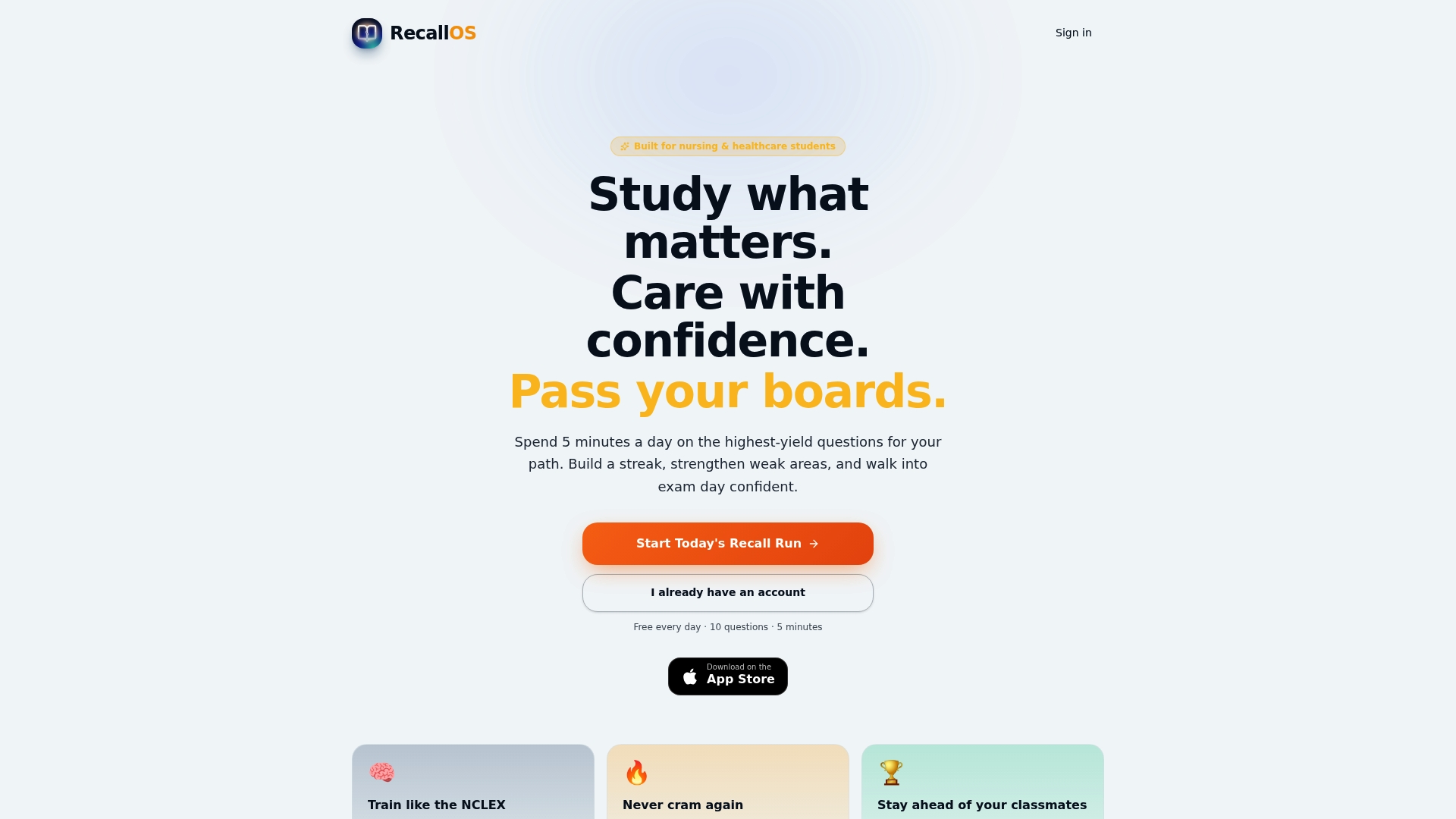
You can also upload your own notes and generate flashcards, quizzes and summaries from them, so you practice with your course material. Start with the Daily Recall Run, or see our NCLEX study app if you are preparing for licensure. Plans and in-app purchase details are on the RecallOS home page.
FAQ
How can I learn and retain information for the long term?
Use retrieval practice and spacing together. Quiz yourself on material, then return to it across days and weeks instead of in one sitting. Reviews of the research favor these methods over rereading and massed study, even though they feel harder.
What is the 1-3-5-7 rule in studying?
It is a review schedule: revisit new material one, three, five and seven days after you first learn it. The exact intervals are not from a head-to-head trial that we could find, but the idea of spaced, self-tested reviews is well supported. Use it as a template and adjust to your exam date.
Which study technique is best for nursing students?
A 2019 review in Nursing Education Perspectives points to practice testing and distributed practice as high-utility strategies. In practice, that means daily question sets on exam-style content, with missed items returning for review.
Does cramming ever work?
It can help you recognize material for a test tomorrow, but it is a poor bet for licensing and certification exams that draw on months of content. Spacing across several days is the approach nursing programs such as WSU's recommend over cramming.
Sources
- Which Study Strategies Are Nursing Faculty Recommending?
- Remembering What We Learn (PMC)
- An Evidence-Based Guide for Medical Students
- The science of effective learning with spacing and retrieval practice
- The Use of Retrieval Practice in the Health Professions
- Test-enhanced learning in health professions education
- MIT Teaching + Learning Lab: Help Students Retain, Organize and Integrate Knowledge
- Retrieval-based learning (Purdue Learning Lab)
- WSU College of Nursing: General Test Preparation
- Systematic review of distributed practice and retrieval practice
- Spacing and retrieval (Australian Education Research Organisation)
- Reviewing Material: Nursing School Success
- Durable Learning Strategies in Nursing Education