
The best study rewards are small, specific and decided before you sit down: a hot drink after a block of practice questions, a night out after a finished unit, a bigger treat when an exam is behind you. This guide gives you ideas at every price, shows you how to turn them into a simple points system, and covers rewards that suit nursing and NCLEX prep in particular. It also covers how to keep a reward from replacing the studying it is meant to support.
TL;DR
- Match the size of the reward to the size of the goal: small treats for a session, mid-size ones for a week, a big one for a milestone.
- Free rewards work. A song, a walk, a hot drink or a stretch are enough for short breaks.
- Reward the task you control (for example, finishing 50 practice questions), not only the outcome (a score).
- Set prices in advance and only spend what you have earned.
- Never use punishment as your motivator. Reward achievable progress instead.
Table of Contents
- Why rewards help you study
- Match the reward to the size of the goal
- Free and low-cost rewards for after a session
- Build a points system you will actually follow
- Turn the to-do list into a game
- Rewards for nursing students and NCLEX prep
- Keep rewards from taking over
- Our perspective
- Put your rewards on top of daily practice
- Sample one-week reward plan
- FAQ
- Sources
Why rewards help you study
Most students know what they should do tonight. The trouble is that the payoff for studying (a pass, a license, a career) sits months away, while a phone, a nap or a show is right here. Economists call this present bias. A working paper from the National Bureau of Economic Research found that task-based goals, such as completing a set number of online practice exams, had large and robust positive effects on task completion and course performance among college students. The same paper describes these goals as low-cost and scalable, and says they speak directly to the present-bias problem.
The practical lesson: give yourself something concrete to aim at today, and attach a payoff you can enjoy today. A reward is a bridge between the effort now and the benefit later.
Notice what the researchers tied goals to: tasks, not grades. You cannot fully control whether you score well on a given exam, but you can control whether you finish the questions you planned. Rewards that follow tasks stay fair and stay motivating, even in a week when the results disappoint.
Match the reward to the size of the goal
The Rutgers Learning Centers guide to building an effective reward system suggests setting short-, mid- and long-range goals and pairing each with a reward, from a TV break to a social outing to a larger purchase. Coursera's study habits article draws a similar line: small rewards such as a quick game, a hot drink or a short TV episode, and bigger ones such as a favorite meal or time with friends.
Here is how that looks for a nursing student working toward an exam.
| Goal size | Example goal | Example reward |
|---|---|---|
| Session | 25 minutes of focused practice questions | Favorite song, stretch, hot drink |
| Day | Daily question set finished plus review of every miss | One episode of a show, a walk outside |
| Week | Five study days completed, weak topics reviewed | A favorite meal, a movie, time with friends |
| Unit | Finished a full content area, such as cardiac or pharmacology | A day trip, a new book, a workout class |
| Milestone | Exam taken, clinical rotation finished, or NCLEX done | A real celebration, a trip, a larger purchase |
Keep the gaps proportional. If you give yourself a big treat every day, it stops feeling like a treat and starts feeling like a habit that costs money. If the only reward is the day you pass the NCLEX, months of effort go unmarked.
Free and low-cost rewards for after a session
You do not need a budget for this to work. The team at Habit Rewards says that small, guilt-free activities are ideal for short breaks between study sessions, and lists listening to a favorite song, a short walk outside, a favorite hot drink and a few minutes of stretching or yoga. The University of Vermont's list of free or inexpensive rewards adds music selection, extra computer time and positive recognition.
Some ideas that fit a nursing student's schedule:
- Pick the playlist. Study in silence or with your usual background, then play whatever you want for five minutes.
- Step outside. After a block at the desk, a short walk in daylight is a reward and a reset.
- Make the good coffee or tea. Save the one you like best for after a session, not before.
- Stretch. If you have been sitting through lectures and clinical shifts, a few minutes of stretching feels better than another scroll.
- Text a friend. Sharing that you finished is a small social reward, and it creates accountability.
- Watch one episode. One. Decide that before you start.
- Cross it off. A visible checklist is a reward in itself.
Reward yourself with recognition
The cheapest reward is also one of the most overlooked. The Memorial University of Newfoundland's academic success center says that congratulating yourself or acknowledging what you did is a fundamental part of the reward process, because it reinforces the habit of making progress. After a hard set of questions, say it plainly: I did what I planned. It sounds minor, and it is the step most tired students skip.
The Rutgers guide makes a related point about intrinsic rewards. After a milestone like an A on an exam, take a moment to connect the result to the changes you made in how you studied. That link is what makes the behavior stick for the next exam.
Build a points system you will actually follow
If single treats feel random, a points system gives the whole thing structure. The Habit Rewards guide describes three parts: assign point values to different types of study units, build a menu of rewards with fixed prices, and only spend what you have earned. The company stresses that fixed prices matter, because otherwise a tired student negotiates the price down in the moment.
A simple version:
- Value your units. For example, 1 point for a 25-minute focused block, 2 points for a set of 25 practice questions with every rationale read, 3 points for reviewing a weak topic from scratch.
- Write the menu. 2 points buys an episode of a show. 10 points buys a favorite takeout meal. 30 points buys a bigger outing.
- Set a daily cap. Decide how many points can be earned in a day so one marathon night does not fund a month of treats.
- Track it somewhere visible. A notes app, a sheet of paper on the wall or a habit tracker all work.
- Spend only what is in the bank. No borrowing against tomorrow's studying.
If you want real money to be part of the menu, the same discipline applies to it. A jar that fills with a few dollars per study hour is fine, as long as the withdrawal rules are written down. Setting a limit before you spend works much like the habit of budget tracking for students: decide what each item costs, then keep a running balance so rewards never drift past what you planned.
If you want to see how a weekly record fits around your points, our 10 to 15 minute weekly study habit tracker walks through a short review you can pair with it.

Turn the to-do list into a game
Some students do better when the system looks like a game. The University of Southern California's wellness site suggests Productivity Bingo: you fill a grid with tasks, check them off as you go, and earn a reward of your choice when you complete five squares in a row.
A nursing version might include squares like these:
- Finish the daily question set
- Review every wrong answer and write one sentence on why
- Make flashcards on one medication class
- Do a 25-minute block with the phone in another room
- Teach one concept out loud to a classmate or the wall
- Review a weak topic from last week
- Sleep at least your target hours
- Read one chapter section
- Do a short practice quiz on a topic from clinicals
The grid works because it is flexible. You can pick the easiest line on a bad week and the hardest on a good one, and every square still counts toward something.
Rewards for nursing students and NCLEX prep
Nursing study has its own rhythm. Content is heavy, exams are high-stakes and practice questions are the main tool for building test skill. Rewards should follow that rhythm.
Reward the practice, not just the score
A daily practice target is a good unit to reward. Finishing a set of questions and reviewing the rationales is something you did, regardless of how many you got right. If you tie rewards only to scores, a hard topic becomes something to avoid. If you tie them to showing up and reviewing misses, hard topics become part of the plan.
There is also a research angle. A 2024 article in the International Journal of Nursing Education Scholarship looks at digital badges supporting daily study activities within a weekly licensure-preparation plan, and describes how a visual to-do list can encourage students to set and commit to academic goals. A badge is a reward with no price tag, and it works because you can see your progress pile up.
Streaks work in a similar way. If you like that approach, our post on 10 to 15 minute study streaks for nursing students covers how short daily sessions keep motivation going, and our overview of gamified studying benefits covers the evidence in more detail.
Make it competitive with classmates
Nursing cohorts are close, and a little friendly competition can help. A 2025 feasibility study in PLOS Digital Health looked at game-based learning for nursing students, including competitive quizzes with a leaderboard and prizes, and found a small positive effect on knowledge retention. It was a feasibility study, so treat it as encouraging rather than conclusive.
Try this with your study group:
- Each person completes the same practice set during the week.
- Whoever finishes with the most reviewed rationales (not the highest score) picks the group's coffee spot.
- Rotate the rule each week so it does not become about who is already strongest.
Teaching approaches that involve you actively also seem to help. A 2021 systematic review found that applied and participatory teaching methods improved nursing students' academic motivation. So when you design your own rewards, favor ones that involve doing something (a quiz battle, a teach-back session) over ones that only involve consuming something.
Reward milestones along the way to the exam
A long NCLEX timeline needs checkpoints. Some ideas:
- End of each content area: a meal out or a day with no studying.
- First full practice exam finished: a movie night. Finishing it is the achievement, whatever the score.
- Two weeks of hitting your daily target: something you have been putting off buying.
- Exam day: plan the celebration in advance and put it on your calendar. It gives you something to look forward to when the final weeks feel long.
For help organizing the days around class and clinicals, see our nursing student study routines.
Keep rewards from taking over
Rewards fail in predictable ways. Here is how to avoid them.
Don't use punishment. The Harvard Academic Resource Center warns against using punishments as motivators and recommends focusing on rewards for achievable progress, which helps you keep a positive sense of self-worth. If you miss a day, the answer is not to take something away. It is to return to the plan tomorrow.
Use your breaks as the reward. The Memorial University guide recommends the Pomodoro technique: four 25-minute work cycles followed by a long break of 20 to 25 minutes as a reward for sustained effort. If you want to test that rhythm, our guide to 25/5 Pomodoro study breaks for NCLEX prep lays out a two-week trial.

Make the study session itself less dull. Stanford's Center for Teaching and Learning suggests small supports such as fidgets, music or chewing gum to make tasks more engaging. These are not rewards for finishing, but they can make it easier to start.
Pick rewards that do not eat the study time. An episode that turns into a season, or a social outing the night before a test, is a reward that cancels the work. Decide the length of the reward before you begin, and set a timer if you need to.
Don't let a reward become the goal. If you find yourself doing the minimum for the points, tighten the rule: the unit counts only when you have reviewed the rationale for every miss.
Our perspective
We build a study tool for nursing and healthcare students, and the pattern we see is the same one the research describes: students rarely lack effort, they lack a reason to start tonight. Our view is that the best reward is a small win you can feel quickly. That is why we focus on daily, high-yield practice rather than occasional long cram sessions, why we show instant rationales after each question, and why we track streaks and progress.
We also think rewards should follow behavior, not talent. A student who reviews their weak areas every day is doing the thing that matters, whether or not that day's score was high. So we suggest setting your reward rules around the habit (questions finished, misses reviewed) and letting the results follow. External treats are welcome. The feeling of seeing your streak grow and your weak spots shrink is often the one that lasts, and it is the one you carry into exam day.
Our content is written with practicing nurses and CRNAs so that the practice you are rewarding actually lines up with what the exams test. Time spent on random trivia is not worth celebrating.
— Caleb
Put your rewards on top of daily practice
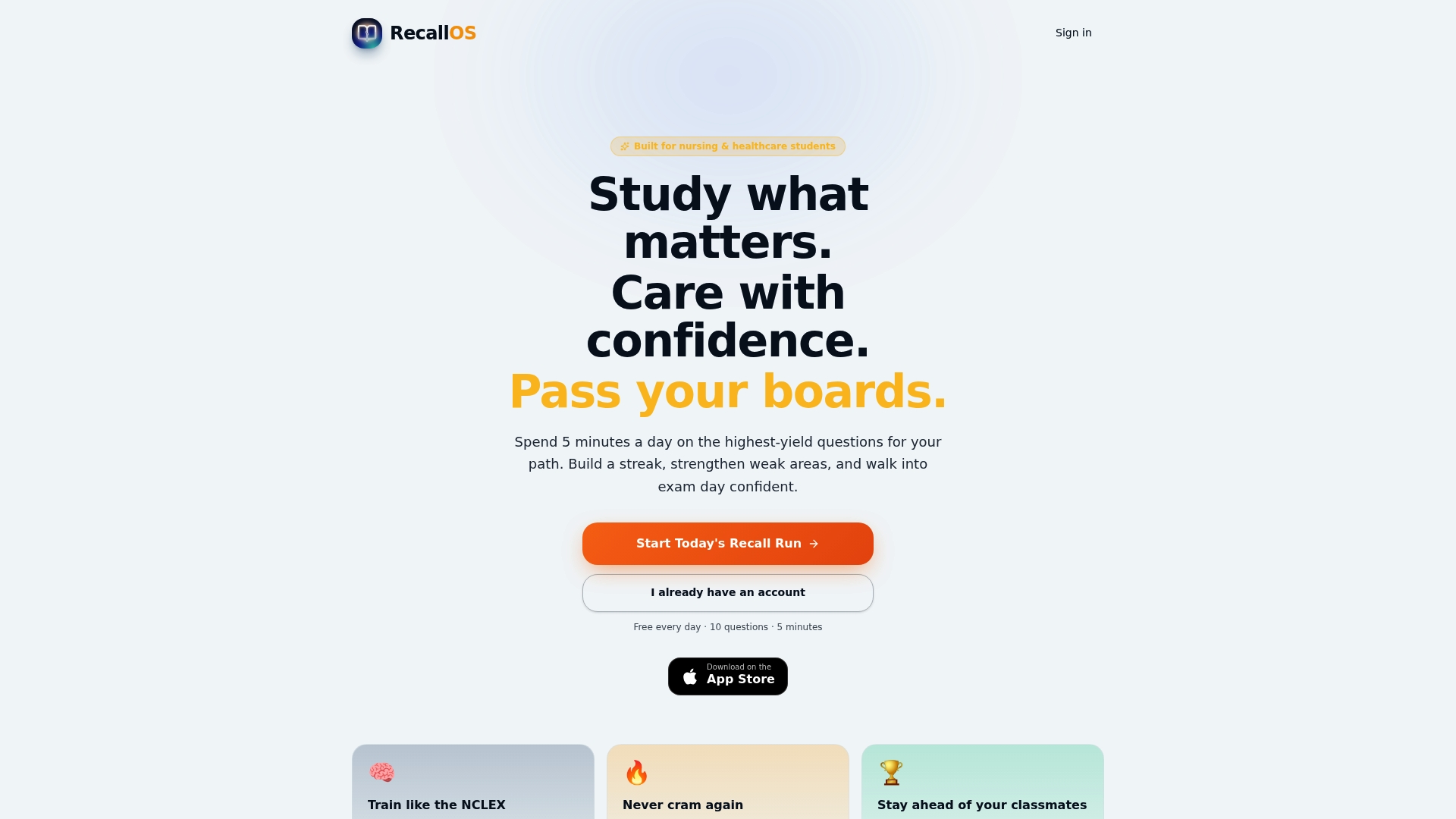
A reward plan works best when there is a clear daily task to attach it to. With RecallOS, that task is the Daily Recall Run: a short set of high-yield practice questions with instant rationales, personalized review of your weak areas, and streaks and rewards that track your progress. You can also challenge peers, and you can upload your own notes to generate flashcards, quizzes and summaries.
If you are preparing for the NCLEX, start with our NCLEX study app. If you want to see the plans and what each includes, visit RecallOS, and read our subscription terms before you subscribe. Pair each completed run with a reward from your menu and you have a daily loop that is easy to keep going.
Sample one-week reward plan
Here is a plan you can copy and adjust. Replace the rewards with whatever you actually like.
| Day | Task | Points | Reward option |
|---|---|---|---|
| Monday | Daily question set, review all misses | 3 | Favorite playlist and a walk |
| Tuesday | Two 25-minute blocks plus one weak topic | 4 | One episode of a show |
| Wednesday | Daily set plus flashcards from class notes | 3 | Good coffee or tea |
| Thursday | Daily set plus a teach-back to a classmate | 4 | Bank the points |
| Friday | Daily set, then review the week's misses | 3 | Bank the points |
| Saturday | One longer block and a timed quiz | 4 | Spend the week's bank on a meal out |
| Sunday | Rest, plan next week | 0 | A full day off, earned |
At the end of the week, spend what you banked, write down one thing that went well, and adjust the point values if you earned too much or too little. If you notice that you are always finishing early, raise the bar slightly. If you are always short, lower it. The goal is a plan you can keep for months, which matters more than any single week.
FAQ
How do I reward myself for meeting study goals?
Set short-, mid- and long-range goals and attach a reward to each, as the Rutgers guide suggests. A session might earn a hot drink, a week a favorite meal, and a milestone a larger treat. Add a moment of self-acknowledgment each time, since that reinforces the habit.
What are free study rewards?
Listening to a favorite song, walking outside, making a hot drink, stretching and texting a friend all cost nothing. Positive recognition counts too, including crossing off a checklist or congratulating yourself. These work best as short, guilt-free breaks between sessions.
How do I make a reward system for studying that lasts?
Give each type of study unit a point value, write a menu of rewards with fixed prices, and only spend points you have earned. Fixed prices stop you from bargaining in the moment when you are tired. Review the values every week and adjust.
What study rewards suit nursing students?
Tie rewards to practice you can control, such as finishing a daily question set and reviewing every rationale. Badges, streaks and friendly group quiz contests fit nursing cohorts well. Plan bigger rewards for the end of each content area and for exam day.
Can rewards backfire?
Yes, if the reward is bigger than the effort, runs too long or replaces the work. Keep rewards proportional, set their length in advance, and avoid punishments, which Harvard's Academic Resource Center advises against. Reward achievable progress instead.
Sources
- Building an Effective Reward System, Rutgers Learning Centers
- Using Goals to Motivate College Students, National Bureau of Economic Research
- 11 Good Study Habits to Develop, Coursera
- How to Reward Yourself for Studying, Habit Rewards
- 35 Free or Inexpensive Rewards for Individual Students, University of Vermont
- Overcoming Procrastination, Memorial University of Newfoundland
- Productivity Bingo, University of Southern California
- The effectiveness of badging systems, International Journal of Nursing Education Scholarship
- Game-based learning for nursing students, PLOS Digital Health
- The effects of teaching methods on academic motivation in nursing students
- Motivation, Harvard Academic Resource Center
- Sustaining Motivation, Stanford Center for Teaching and Learning