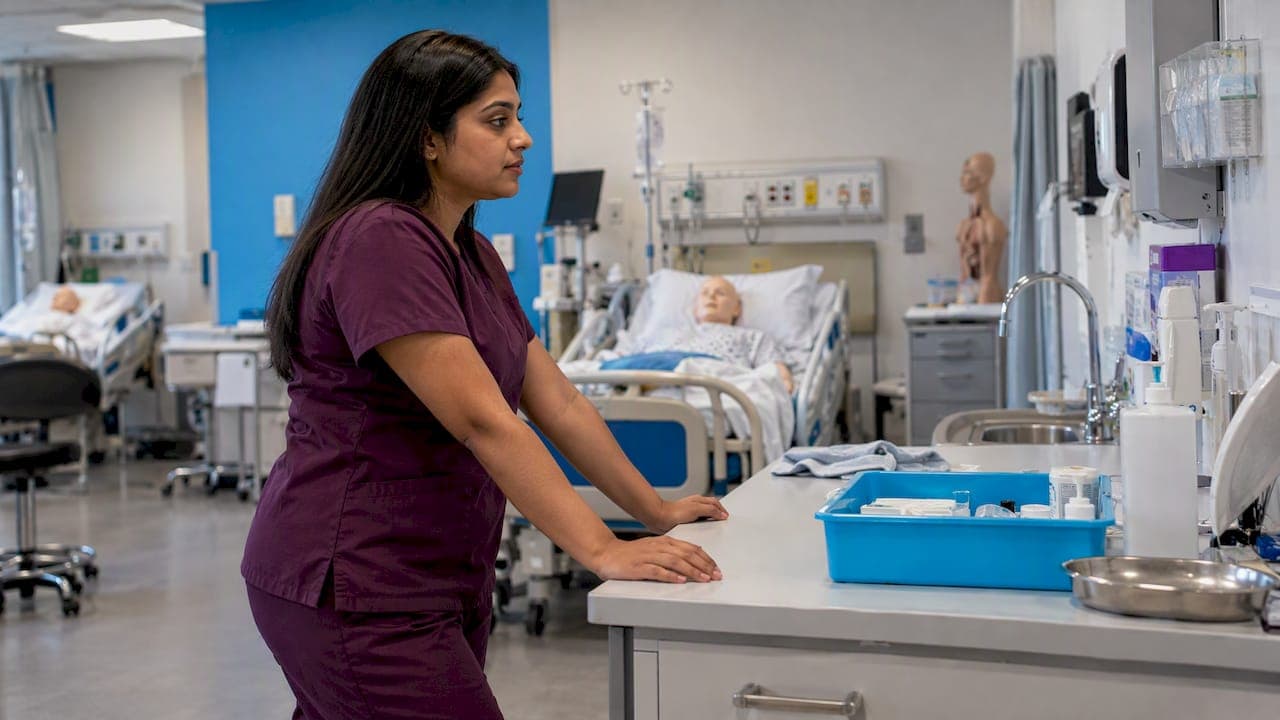
Study burnout in nursing is a state of exhaustion, cynicism and self-doubt that builds up when school and exam pressure never lets up. It is different from a rough week. If you dread opening your notes, feel flat about a career you chose on purpose, or wonder whether you are cut out for this, you may be burned out and not lazy. The way back is usually smaller, steadier study, real rest and support, not a heroic push.
This guide explains what study burnout is, how to spot it, what drives it in nursing programs and NCLEX prep, and how to recover without losing your place in the material.
TL;DR
- Study burnout is chronic: emotional exhaustion, cynicism toward school and a feeling of being incompetent, not just tiredness after a hard exam.
- Common drivers are heavy workload, rigid schedules, peer competition and the pressure of the licensure exam.
- Recovery means cutting load, protecting sleep and movement, using proven stress-reduction tools and asking for help early.
- Short, consistent daily practice usually beats long cram sessions, and it is easier to sustain when you are depleted.
- If you feel persistently hopeless or depressed, talk to a campus counselor or another licensed professional.
Table of Contents
- What study burnout in nursing students really is
- Signs you may be burned out
- What causes burnout in nursing school and NCLEX prep
- How burnout affects memory, focus and exam performance
- How to recover from study burnout
- When to get professional support
- Preventing burnout while balancing class, clinicals and exam prep
- Our perspective: consistency beats intensity
- How RecallOS fits when you are running on empty
- A simple two-week reset plan
- FAQ
- Sources
What study burnout in nursing students really is
Academic burnout in nursing students is described in the research as a multidimensional syndrome: emotional exhaustion, depersonalization or cynicism, and a reduced sense of personal accomplishment. The same review notes that burnout is the result of prolonged exposure to chronic stressors. That word, chronic, is what separates it from ordinary stress.
Here is the practical difference:
| Ordinary stress or tiredness | Study burnout | |
|---|---|---|
| Duration | Peaks around exams, eases afterward | Lingers for weeks or months |
| Feeling | Pressured but still engaged | Drained, detached, cynical |
| Effect of rest | A weekend or a good night helps | Rest barely dents it |
| Self-image | "This exam is hard" | "I am not good at this" |
| Motivation | Present, if strained | Low or gone |
Stress says you have too much to do. Burnout says you no longer care whether you do it. If your reaction to an upcoming exam has shifted from worry to numbness, that is worth noticing.
Nursing students also carry loads that many other majors do not. Research on nursing students points to unique stressors such as witnessing patient mortality, managing complicated relationships in clinical settings and facing possible workplace hazards. You are studying dense science while also learning to function in real clinical environments.
Signs you may be burned out
The reported symptoms of study burnout in nursing students include physical and mental fatigue, cynicism, frustration, anxiety, lack of motivation and poor academic performance. A study of nursing students in South Korea describes the core signs as exhaustion, apathy toward studies and feeling incompetent.
In daily life that can look like:
- Reading the same paragraph three times and retaining nothing.
- Putting off practice questions because even starting feels heavy.
- Snapping at classmates or feeling bitter about assignments you used to tolerate.
- Sleeping badly, or sleeping a lot and still waking up tired.
- Scores dropping even though you are logging more hours.
- Thinking about quitting nursing school more often than you admit.
A useful self-check: ask whether the feeling lifts when the pressure does. If a break after finals restores your interest, you were probably stressed. If a full break still leaves you empty, treat it as burnout.
What causes burnout in nursing school and NCLEX prep
The South Korean study identifies several contributors: a significant workload, an inflexible curriculum, competition between peers and preparation for the nurse licensure exam. That study is from one country, but anyone who has sat through a U.S. nursing program will recognize the pattern.
Workload that never ends
Lectures, care plans, clinical hours, skills checkoffs and exams arrive in parallel. When every day is full, there is no recovery period, and chronic stress is exactly what drives burnout.
Studying in the wrong way
Burnout is not only about studying too much. A study at a private university in California found that students who spent less than five hours per week studying for exams reported more exhaustion. One reasonable reading is that panic cramming and avoidance, not steady work, leave students feeling overwhelmed. Study time that is regular, planned and focused tends to feel more manageable than a pile-up the night before.
Comparison and competition
Cohorts are tight, and everyone seems to be doing more than you. Constant comparison turns each practice score into a verdict on your worth.
The shadow of the licensure exam
The NCLEX looms over the whole program. When every quiz feels like a rehearsal for a pass-or-fail event, your nervous system stays switched on. If test anxiety is the main piece for you, our guide on managing NCLEX test anxiety goes deeper.
Money and life outside school
Work shifts, family duties and bills add load that no study plan can erase. Small fixes still help. A simple student budget checklist can remove one recurring worry from your head during a heavy term.
How burnout affects memory, focus and exam performance
A systematic review of burnout among nursing students warns that unmanaged burnout can lead to reduced academic performance, compromised mental health and eventual attrition from the profession. In plain terms, burnout hurts the exact things you are trying to protect.
What you may notice while studying:
- Concentration: your attention drops out mid-page, so sessions get longer and less productive.
- Recall: you recognize terms but cannot pull them up when a question asks for application.
- Motivation: you avoid practice questions because wrong answers feel like proof you are failing.
- Judgment: NCLEX-style questions reward clinical reasoning, which is harder when you are depleted.
This creates a trap. Poor results make you study more, more study deepens the exhaustion, and the cycle repeats. Breaking it means changing the shape of your studying, not only its amount.
How to recover from study burnout
Recovery is gradual. Treat it as a few weeks of deliberate adjustment, not a single day off.
1. Lower the load before you try to fix anything
List everything on your plate and mark what is truly required this week. Talk to an instructor or advisor about extensions, reduced load or schedule changes if you are near a breaking point. Doing this is not weakness; it is the kind of triage you will do for patients.
2. Protect sleep, movement and real breaks
Public health researchers note that physical activity is often overlooked among college students despite its proven ability to improve cognitive function and academic performance and to reduce anxiety. A daily walk is not a reward for finishing studying. It is part of studying.

3. Use tools with evidence behind them
The academic review of burnout in nursing students lists progressive muscle relaxation, mindfulness education, recreational music-making and behavioral therapy sessions as interventions that help reduce it. You do not need all of them. Pick one, such as a ten-minute guided relaxation before bed, and keep it up for a couple of weeks.
4. Rebuild with very small study blocks
When you are depleted, set a floor instead of a goal: ten to fifteen minutes of focused practice, once a day. The point is to restore the feeling that you can do this. Our piece on 10 to 15 minute study streaks explains how short, repeated sessions rebuild momentum, and our motivation guide for nursing students covers what to do when the drive is gone.
5. Reconnect with people
Talking to a classmate who feels the same way often cuts the isolation fast. Use groups for explaining and quizzing, and solo time for first-pass learning. Our peer versus solo studying checklist shows how to split the two so group time does not turn into venting that eats the afternoon.
When to get professional support
Self-help has limits. Seek out a professional if you notice:
- Low mood, hopelessness or loss of interest in nearly everything for more than a couple of weeks.
- Panic attacks, or anxiety that keeps you from attending class or clinical.
- Thoughts of harming yourself. If this is happening now, call or text 988, the Suicide and Crisis Lifeline in the U.S., or go to the nearest emergency department.
The American Psychological Association notes that students with acute concerns, including depression, can access one-on-one sessions with professional counselors. It also reports that many U.S. campuses offer a range of resources, including telehealth platforms, wellness apps, peer counseling and stress-management workshops. Start with your school's counseling center or student health office. If you are a working nurse or in a certification program without campus access, your primary care clinician or employer assistance program is a sensible first call.
Preventing burnout while balancing class, clinicals and exam prep
Prevention beats recovery. The APRA-style takeaway from campus health experts is cultural: the APA describes wellness as something to build into daily campus systems rather than leave to the counseling center alone. For you, that means building rest into the schedule instead of waiting for a crisis.
Plan the week, not just the day. Give each course and clinical a fixed slot and leave one block empty for overflow. Our weekly time management system walks through this, and the 6 to 12 week nursing school study plan gives you copy-ready templates.
Study in short, retrieval-based sessions. Quiz yourself instead of rereading. Explaining a concept out loud as if to a patient is also effective, and the teach-back method shows how.
Track habits, not hours. A small weekly check of whether you studied, slept and moved is more telling than a count of hours. Try the 10 to 15 minute weekly habit tracker.
Keep a stop time. Pick an hour after which you do not study. Your brain consolidates what you learned while you rest.
Schedule one thing that is not nursing. Music, a run, dinner with friends. The review literature includes recreational music-making among helpful interventions, so this is not indulgence.
Our perspective: consistency beats intensity
We build RecallOS with practicing nurses and CRNAs, and the pattern we see in exam prep is consistent: the students who struggle most are rarely the ones who study too little in a single session. They are the ones who alternate between avoiding the material and trying to make up for it in marathon nights. That swing is exhausting, and it turns every practice question into a referendum on whether you will pass.

Our view is that burnout is partly a design problem. If studying means facing a mountain of random questions with no sense of progress, anyone would dread it. High-yield questions mapped to real exam blueprints, a short daily set, review that returns to your weak areas and visible streaks make the work smaller and the progress easier to see. A wrong answer then becomes information about what to review next, not a verdict on you.
We also think rest is part of the plan. A streak is a tool, not an obligation. If you are exhausted, the right move may be a ten-minute set and an early night, or a day off and a conversation with a counselor. No app replaces sleep, support or professional care.
— Caleb
How RecallOS fits when you are running on empty
If you are rebuilding your study habit, the goal is a low-friction routine you can sustain. The Daily Recall Run gives you a short daily set of high-yield questions, with instant rationales and personalized review of weak areas, so you are not deciding what to study while tired. You can also upload your own notes and turn them into flashcards, quizzes and summaries instead of rewriting everything by hand. If you are preparing for the licensure exam, see the NCLEX study app page, and the Recall+ and Recall Pro plans for the full feature set.
A simple two-week reset plan
If you want something concrete to follow, try this for fourteen days:
- Days 1 to 2: write down every obligation and cross off anything that can wait. Message an advisor or instructor if you need relief on a deadline.
- Days 3 to 7: study for no more than 15 to 20 minutes a day, using questions instead of rereading. Walk for at least 20 minutes daily and set a fixed bedtime.
- Days 8 to 10: add one relaxation practice, such as progressive muscle relaxation, and one social check-in with a classmate or friend.
- Days 11 to 14: increase to two short sessions a day if your energy allows. Review which topics came up wrong most often and put those at the front of the next week.
At the end of two weeks, ask yourself the same questions as before: how drained, how cynical, how capable do you feel? If nothing has shifted, that is a signal to book time with a counselor, not to push harder.
FAQ
Is it normal to want to quit nursing school because of burnout?
It is common to have that thought during a stretch of chronic stress, and it is a recognized part of burnout. The thought alone does not mean you chose the wrong career. Give yourself a recovery period and talk to an advisor or counselor before making a permanent decision.
How long does it take to recover from study burnout?
There is no fixed timeline, and it depends on how long you have been under strain and how much load you can remove. Many students notice small improvements within a few weeks of cutting load, sleeping more and studying in short blocks. If you feel no better after that, seek professional support.
Should I stop studying completely to recover?
A short full break can help, especially after a big exam. For most students, a smaller and steadier routine works better than stopping for long, because it keeps the material fresh without recreating the overload. Ten to fifteen focused minutes a day is a reasonable floor.
How do I know if it is burnout or depression?
They overlap: both can bring exhaustion, low motivation and trouble concentrating. Burnout is tied to school and work pressure, while depression usually affects most areas of life, including things you used to enjoy. Only a licensed professional can tell them apart, so see a counselor or clinician if low mood persists.
Sources
- Evolution and Treatment of Academic Burnout in Nursing Students (PMC, 2023)
- Factors affecting academic burnout of nursing students (BMC Medical Education, 2022)
- The incidence of nursing students' perceived stress and burnout (Journal of Nursing Education and Practice)
- Nursing students' academic burnout: its prevalence and associated factors (PMC, 2025)
- A Systematic Review of Burnout Among Nursing Students (British Journal of Hospital Medicine)
- Student mental health is in crisis. Campuses are rethinking their approach (APA, 2022)
- Bridging the Gap: Promoting Physical Activity in College Students (CDC, 2025)