
You can generate a good quiz from a textbook in about an hour per chapter. Pick one chapter, write down what you should be able to do after reading it, feed that chapter and those objectives to an AI tool or write the questions yourself, then check every answer key against the page. The checking step is what separates a quiz that teaches from one that wastes your evening.
This guide is written for nursing and healthcare students, but the method works for any dense textbook. It covers how to choose material, how to write stems and answer choices, which formats to practice, how to build an answer key with rationales, and how to use your results to decide what to review next.
TL;DR
- Quiz one chapter or section at a time, with its learning objectives, rather than pasting a whole book.
- Map objectives to questions first, so every question tests something you actually need to know.
- Write (or prompt for) a clear stem, one defensible key and plausible wrong answers of similar length and style.
- Verify every AI-generated question and key against the chapter before you trust it.
- Retake quizzes, track what you miss, and feed weak areas back into the next session.
Table of Contents
- Start with one chunk, not the whole book
- Write learning objectives before you write questions
- Generate the first draft
- What makes a question worth answering
- Question formats and difficulty for nursing practice
- Build the answer key and rationale
- Check every question against the chapter
- Perspective: what we think about textbook quizzes
- Use results and spaced review to close gaps
- Skip the assembly with RecallOS
- FAQ
- Sources
Start with one chunk, not the whole book
The most common mistake is uploading an entire textbook and asking for "a quiz." You get broad, shallow questions that drift toward trivia. Instead, shrink the job.
A university test-construction exercise advises selecting one unit that is about 1/12 of the book, whatever the book calls it, chapter or unit. In a 36-chapter pathophysiology text, that is roughly three chapters, but for self-study one chapter at a time is easier to verify and finish.
Chapter structure helps you decide what to cover. In a well-built textbook, chapters map to major topics and the sections inside them map to subtopics that can stand alone. Treat each section heading as a candidate cluster of questions.
If your course is also assigning lectures, read the textbook alongside your objectives. Vanderbilt's Center for Teaching notes that effective practice tests depend on coordinating course objectives with the reading, including content the textbook covers that lectures skip.
Write learning objectives before you write questions
Objectives are the filter. Most chapters list them at the start. If yours does not, write three to six yourself, each starting with a verb: identify, prioritize, differentiate, calculate, recognize.
The verb sets the level of the question. The same guidance on planning textbook content recommends using Bloom's taxonomy to specify the level of learning you will assess. "List the signs of hypoglycemia" is recall. "Choose the first nursing action for a diabetic client who is sweating and confused" is application. Nursing exams lean heavily toward the second kind. If you want a deeper walk-through of this, see our guide to Bloom's taxonomy mapped to NCLEX study routines.
Build a simple two-way chart
A two-way chart, also called a table of specifications, maps learning outcomes to the quiz content so nothing important is left out and nothing trivial sneaks in. Here is a quick version for a chapter on heart failure:
| Objective | Level | Questions |
|---|---|---|
| Differentiate left-sided from right-sided failure signs | Understand | 2 |
| Prioritize nursing actions for acute pulmonary edema | Apply | 3 |
| Identify expected effects of diuretics | Understand | 2 |
| Recognize teaching points on daily weights | Apply | 2 |
Two minutes with a chart like this tells you whether a generated quiz is balanced or has twelve questions on one table and none on the thing your instructor stressed.
Generate the first draft
Whether you use an AI tool or write by hand, give the same inputs.
- One chapter or section of text, pasted or uploaded.
- The learning objectives for that section.
- The format you want, for example multiple choice with four options, or select-all-that-apply.
- The level, for example application-level questions with a short clinical scenario.
- An answer key with a short explanation for every option.
This mirrors a published guide to using AI for quizzes, which recommends dividing a textbook into chapters or sections, pasting one chapter with the learning outcome and desired question format, and asking for an answer key with one-sentence explanations.
A prompt that works well: "Using only the text below, write 10 application-level multiple-choice questions for nursing students. Each has a short patient scenario, four options, one best answer, and a rationale explaining why the key is right and why each other option is wrong. Do not use outside information."
The phrase "using only the text below" matters. It keeps the quiz tied to your textbook instead of whatever the model remembers.
If you want a fuller overview of the tool side, we cover it in our AI quiz generator guide, and the four-stage workflow with human review in making quizzes from notes.
What makes a question worth answering
A generated question is only as good as its construction. Item writers for licensure exams follow a repeatable process, and you can borrow it.
The NCSBN's tutorial for writing REx-PN items lays out seven steps: review the test plan and select an activity statement, select a nursing concept, locate references, write the stem, write the key, write the distractors, and review the item. Notice that the reference comes before the question, and review comes after. Both are steps an AI tool will not do for you.
Stem: one clear task, with clinical context
A 2024 article in the Journal of Continuing Education in Nursing describes an evidence-based approach to multiple-choice questions that starts with an assessment blueprint and stresses that appropriate clinical context in the question is essential. Compare:
- Weak: "Which of the following is a symptom of digoxin toxicity?"
- Stronger: "A client taking digoxin reports nausea and seeing yellow-green halos around lights. Which action should the nurse take first?"
The second tests judgment, not a memorized list, and it looks much more like what you will meet on exam day.
Options: plausible, parallel and unhelpful as clues
A 2023 educator's guide to writing multiple-choice questions lists ten strategies, including writing succinctly, using plausible foils and avoiding grouped options. The same authors note that building the answer set is one of the hardest steps, because the wrong answers must be distinct from the correct one while matching it in length, voice, grammar, syntax and verb tense so they do not give the answer away.
A quick scan of your generated quiz will catch most problems:
- Is the correct answer noticeably longer or more detailed than the others?
- Do two options say nearly the same thing?
- Is there an "all of the above" or "none of the above" crutch?
- Could you eliminate options by grammar alone?
If yes to any, rewrite the option or drop the question.
Question formats and difficulty for nursing practice
Mix formats so you practice recognizing content in more than one way.
| Format | Best for | Watch out for |
|---|---|---|
| Single-best-answer multiple choice | Prioritization, first-action and safety questions | Options that differ in length |
| Select all that apply | Lists of signs, interventions, teaching points | Partial knowledge that feels like mastery |
| Fill-in-the-blank or calculation | Dosage math, lab values, formulas | Units and rounding rules |
| Ordered response | Sequences such as steps of a procedure | Steps that vary by facility policy |
| Short written recall | Mechanisms and definitions before you can recognize them | Self-grading too generously |
Select-all-that-apply questions deserve their own practice because the scoring logic and error patterns are different. Our SATA NCLEX strategy guide breaks down how to approach them.
For difficulty, build a ladder inside each chapter. Start with a few recall questions to confirm you read the material, then move most of the quiz to application and prioritization. A practical split for a ten-question quiz is two or three recall, five application and two or three analysis questions with a longer scenario. Adjust toward harder items as your scores climb.

Build the answer key and rationale
A quiz without rationales is a score. A quiz with them is a lesson.
One guide on writing assessment questions with AI advises that for each question you explain why the correct answer is right and why common wrong answers are wrong, and that you spend more time on the wrong answers, since students who answered correctly do not need the explanation. That fits how nurses learn: knowing why the tempting option fails is how you stop falling for it.
A good rationale has three parts:
- The reason the key is correct, in one or two sentences.
- The reason each distractor is wrong or less appropriate.
- The page, section or heading in the textbook where the point lives, so you can go back.
Check every question against the chapter
AI tools can produce fluent questions that are simply wrong. One walkthrough on turning a chapter into a quiz warns that these tools can be confidently wrong and suggests three checks for each question: Is the keyed answer correct and supported by this chapter? Is there a second defensible answer? Could someone answer it without reading? The same piece points out that a polished quiz with a wrong key does more harm than no quiz, because it teaches the wrong thing.
Professional exam bodies use the same discipline. The NBCRNA's 2025 item development guidelines tell reviewers to verify that a correct answer is actually correct and that the keyed answer can be defended if challenged. Apply that standard to your own quiz.
A fast review routine:
- Read each stem and answer it yourself before looking at the key.
- Find the sentence in your textbook that supports the key. If you cannot, flag the question.
- Try to argue for a second option. If you can, rewrite or delete.
- Delete any question that rewards trivia, such as an obscure date, a rare eponym or a number nobody uses at the bedside.
- Where the question touches a clinical standard, such as a drug dose, a lab range or a guideline recommendation, confirm it with your course materials or the current official guidance, since textbooks age and editions differ.
That last step matters most for nursing. Your textbook is the starting point, but the NCLEX is built from a published test plan, and practice items should line up with it. Ask your instructor or review the current plan from NCSBN to confirm your quiz covers the client-need categories you will be tested on.
Perspective: what we think about textbook quizzes
We build RecallOS with practicing nurses and CRNAs, and we see the same pattern in every student who struggles with recall: they read a lot and test themselves too little.
A textbook is an excellent source and a poor study plan. Turning a chapter into questions forces you to decide what matters, and answering them forces your memory to work. That is the whole idea behind active recall, and it is why our Daily Recall Run puts a short set of high-yield questions in front of you every day instead of asking you to reread.
Where we think generated quizzes should go further is in what happens after the score. A quiz is most useful when it remembers what you missed and brings it back. That is the thinking behind our adaptive review of weak areas, and why we let you upload your own notes and materials to generate flashcards, quizzes and summaries from them. Your material, our structure, and a human check on anything that touches patient safety.
Use the method in this article by hand if you like. If you would rather spend your time answering questions than assembling them, that is what we built the app for.
Caleb
Use results and spaced review to close gaps
Taking the quiz is half the job. What you do with the results decides whether the chapter sticks.
Online reading quizzes can help. A Penn State Berks report on 25 online quizzes tied to assigned readings, averaging six multiple-choice questions with four options each, found students rated them 4.4 out of 5 for learning and 4.7 for exam preparation, and they could retake the quizzes. The takeaway for you: short quizzes, tied to reading, with retakes allowed.
A simple loop:
- Same day: take the quiz closed-book and read every rationale.
- Log misses: write each missed question's topic, not the question, in a running list.
- Day 2 to 3: retake only the missed items, then a few new ones from the same chapter.
- One week later: mix questions from the chapter into a quiz with earlier chapters.
- Repeat: topics you miss twice move to the top of your next session.
Instructors judge question quality with statistics. The 2023 educator's guide recommends evaluating items after use with the difficulty index and the discrimination index. You can borrow the first one: if you miss a question every time, the question may be flawed, or it may be a true weak spot. Recheck the key before you assume the second.
For ways to measure this over weeks, see our guide on tracking study progress for nursing and healthcare exams, and for fitting chapters into a calendar, turning a syllabus into an AI study plan.
Skip the assembly with RecallOS
If building and checking quizzes by hand eats the time you need for studying, RecallOS does the heavy lifting. You can upload your notes and materials and get custom flashcards, quizzes and summaries, with instant rationales on practice questions and personalized review of the areas you miss.
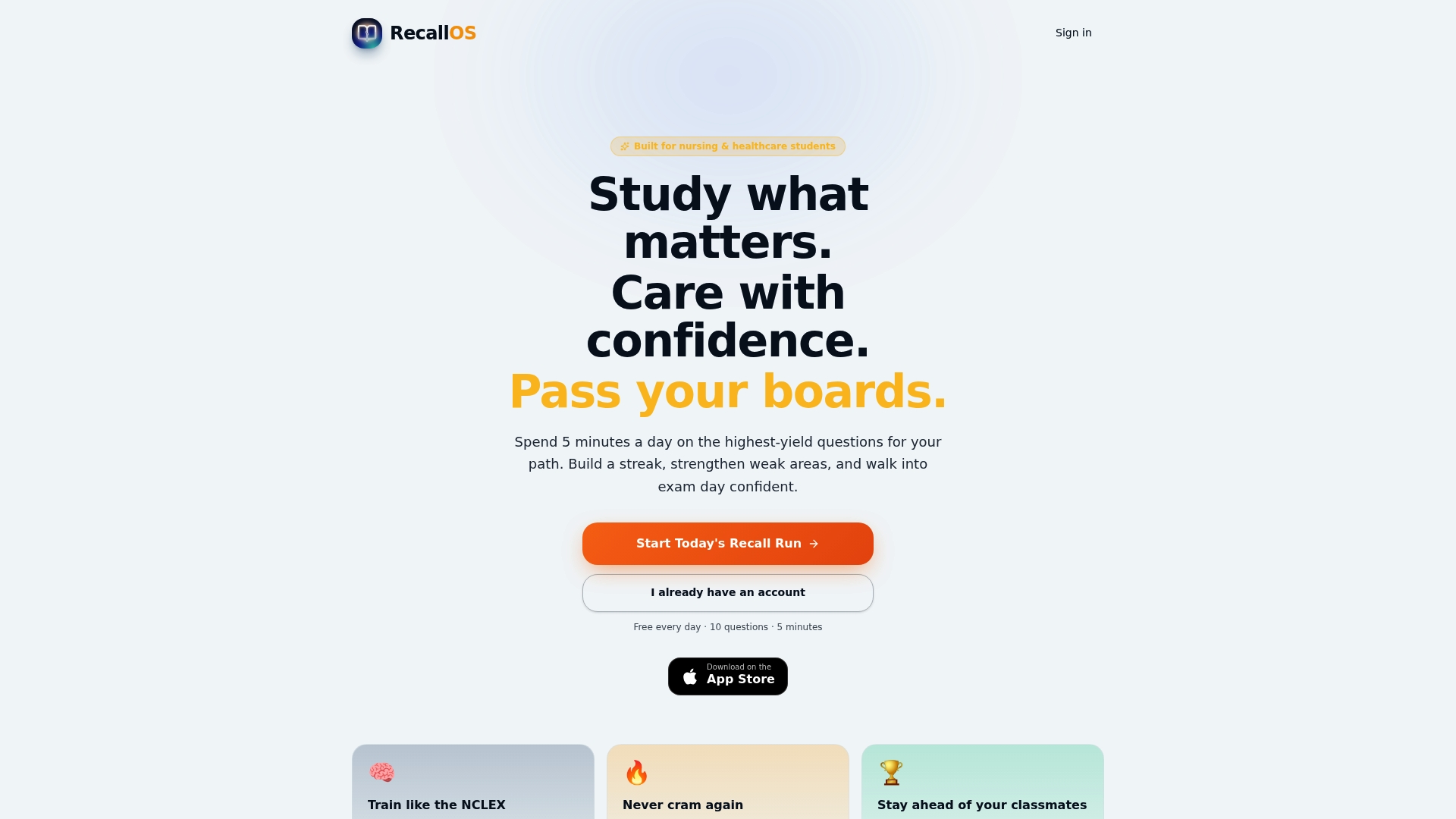
For daily habit-building, the Daily Recall Run gives you a focused set of high-yield questions aligned to real exam blueprints, with streaks and rewards to keep you consistent. Studying for a specific exam? We have pages for the NCLEX, CRNA and SRNA exams and the CCRN. You can see how it works on our adaptive quiz examples.
FAQ
Can AI really generate a quiz from a textbook?
Yes. Give the tool one chapter, your learning objectives and a clear format request, and it will produce a usable first draft in seconds. Treat it as a draft, though. Check each key against the chapter before you rely on it, because generated questions can look right and be wrong.
How many questions should I make per chapter?
Ten to fifteen is a good range for one chapter or section. That is enough to cover each objective with a couple of questions, and short enough to finish in one sitting and review the rationales. Published examples of reading quizzes average around six questions each, so shorter is fine for dense sections.
Is it better to quiz myself or use premade questions?
Both help, for different reasons. Writing or reviewing questions from your own textbook pushes you to decide what matters, while premade high-yield sets give you exam-style practice and breadth. Many students use their own chapter quizzes for coursework and a daily question set for NCLEX-style practice.
How do I know a generated question matches the exam?
Compare it with the exam's published test plan and item-writing guidance. Licensure bodies describe how items are built, starting from the test plan, a nursing concept and a reference. If a question tests trivia or has no support in a reliable reference, drop it.
Can I upload my textbook to RecallOS?
You can upload your notes and study materials to generate flashcards, quizzes and summaries. Start on the Upload Notes page. For work you plan to rely on, give the output the same accuracy check described above.
Sources
- Directions for Test Construction Project, University of Delaware
- Planning Your Open Textbook, Toronto Metropolitan University
- Practice Tests: a Practical Guide, Vanderbilt Center for Teaching
- Section 7: Creating Quizzes, Dr. Fiske's Guide to Using AI
- REx-PN Item Writing Tutorial, NCSBN
- An Evidence-Based Approach to Constructing Multiple-Choice Questions, Journal of Continuing Education in Nursing
- Educator's blueprint: A how-to guide for developing high-quality multiple-choice questions
- How to Write Course Assessment Questions Using ChatGPT, Ruzuku
- Turning a Textbook Chapter Into a Quiz, AI Skill Market
- Item Development Guidelines 2025, NBCRNA
- The Impact of Online Quizzes on Student Engagement, Penn State Berks