
Studying nursing with ADHD works best when you shrink the session, make recall active, and put structure around everything you can't afford to forget. Short reading blocks with movement breaks, daily self-quizzing, a written weekly plan, and early accommodation requests solve most of the problems nursing students with ADHD describe. This guide covers each one, plus how to prepare for the NCLEX.
TL;DR
- Read in 15 to 20 minute blocks, then take a 10 minute break with some movement.
- Turn slides and objectives into questions, then quiz yourself the next day instead of rereading.
- Plan the week on paper: daily goals, fixed study chunks, and a reward built into each break.
- In the U.S., you must disclose your ADHD and request accommodations yourself. For the NCLEX, the request goes through your nursing regulatory body, and you should not schedule the exam until you have your accommodations in writing.
- Short daily practice-question sets beat marathon cram sessions for most ADHD brains.
Table of Contents
- Why nursing school is hard on an ADHD brain
- Build study blocks around your attention span
- Turn passive material into questions
- Plan the week so decisions are already made
- Preparing for the NCLEX with ADHD
- Accommodations in nursing school: what you have to do
- Requesting NCLEX accommodations
- Where RecallOS fits
- FAQ
- Sources
Why nursing school is hard on an ADHD brain
Nursing programs ask for the exact skills ADHD makes slower to build: organizing a huge volume of content, sequencing steps, prioritizing under pressure, and starting tasks that feel vague. A peer-reviewed nursing-education article by Bradshaw and Salzer states that executive-function difficulties are particularly problematic for nursing students with ADHD, and that the diagnosis can complicate coursework and life-skill development.
A later nursing-education paper lists what this looks like in practice: trouble organizing, sequencing and prioritizing, procrastination, difficulty focusing, managing internal and external distractions, impulsive decisions, and starting tasks without reading or listening to directions. The same paper notes that nursing adds a performance-based clinical component, where classroom accommodations alone may not cover real-time medication, prioritization and patient-care demands.
Read that list as a design brief, not a verdict. Each item points to a fix:
| Difficulty | What helps |
|---|---|
| Starting tasks | A fixed, tiny first step (open the question set, answer five items) |
| Sustained attention | Short blocks with scheduled breaks |
| Prioritizing | A written weekly plan with the exam blueprint in view |
| Distraction | A low-distraction study spot and a phone out of reach |
| Following directions | Read the full question stem and instructions before answering |
| Retention | Frequent, cumulative, active recall |
The rest of this article builds out those fixes.
Build study blocks around your attention span
Fighting your attention span wastes energy. Work with it.
The University of Arizona College of Nursing's ADHD tips recommend reading for 15 to 20 minutes, then taking a 10 minute break, ideally with physical activity, and rereading your last notes before you resume. That last step matters: it rebuilds context so you don't spend the first five minutes of every block lost.
A practical block looks like this:
- Set the target before the timer. One chapter section, one set of 10 questions, or one pathophysiology concept.
- Work 15 to 20 minutes. Phone in another room. Notes and a water bottle within reach.
- Move for 10 minutes. A walk, stretching, yoga, or stairs. Not scrolling.
- Reread the last few lines of notes, then start the next block.
For a new block, a short stack of three or four per evening usually beats one three-hour sit. If a subject is dense, like acid-base balance or cardiac drugs, our guide to pathophysiology study strategies breaks the content into manageable pieces.
Use hyperfocus on purpose
Many students with ADHD can focus intensely on topics they find interesting and barely touch the rest. A nursing study guide by Keszler recommends redirecting hyperfocus toward unfamiliar or anxiety-provoking material. In practice: when you feel locked in, spend it on the topic you've been avoiding, whether that's lab values, dosage calculations or endocrine, not on re-polishing notes you already know.
Turn passive material into questions
Reading a slide deck three times feels productive and sticks poorly. For ADHD, passive review is also the easiest way to zone out while your eyes keep moving.
The Arizona tips suggest previewing objectives and turning slides into questions, taking Cornell-style notes, rereading them right after class, and self-quizzing the next day. Add a study buddy to compare notes and fill the gaps you missed.
The University of Reading's guide adds that learners with ADHD may have relatively fragile working-memory capacity and duration, and recommends learning that is structured, cumulative, frequent and multisensory. It also suggests creating structure with headings, keywords, explicit links to prior knowledge, and comparisons between what you know and what's new.
Here is how that translates to a nursing lecture on heart failure:
- Before class: Read the objectives. Write each as a question: "What distinguishes left-sided from right-sided failure at the bedside?"
- During class: Cornell layout. Cues in the left column, notes on the right, a two-line summary at the bottom.
- Within an hour: Reread the notes and fix anything unclear.
- Next day: Cover the right column and answer from the cues. Missed items go on a short "again" list.
- End of week: Mix heart failure with last week's content so the material stays cumulative.
If you want to speed up the conversion step, our walkthrough on making flashcards from your notes takes 10 to 15 minutes, and the study guide from notes method covers condensing a whole unit. For the science of why this works, see our piece on study retention techniques for nursing exams.
Plan the week so decisions are already made
Deciding what to study is often harder than studying. Remove that decision.
The Arizona guide recommends a planner to schedule assignments across the week and plan rewards during breaks, such as a short walk or yoga. Keszler's guide goes further, recommending smaller daily study chunks, written daily and weekly goals, low-distraction environments, study groups, and teaching peers.
A simple Sunday setup:
- Put every class, clinical shift, and due date in one calendar.
- Block 3 to 4 study chunks of 30 to 45 minutes on the days you have the most energy.
- Write one daily goal per chunk, small enough to finish.
- Attach a reward to the break after each chunk.
- Leave one open block for catch-up. You will need it.
If you're mapping a whole semester and deciding which courses to stack, these course scheduling strategies are worth reading before you meet your advisor. For day-to-day structure, our weekly time management system for nursing students lays out a template, and our ideas on study rewards help you pick breaks that actually feel like a reward.
Deadlines also hide in your inbox: clinical site requirements, compliance paperwork, instructor messages. If email is where tasks go to die, this guide to ADHD email management offers a two-pass approach you can adapt to your school account.
Motivation is a system, not a mood
On low-dopamine days, waiting to feel like studying doesn't work. Make the minimum so small it feels silly: 10 minutes, five questions. A visible streak gives you something to protect. Our posts on 10 to 15 minute study streaks and motivation for nursing students go deeper on this.
Preparing for the NCLEX with ADHD
The NCLEX rewards steady exposure to application-style questions, which fits a short-daily-session approach better than a last-minute binge. A workable rhythm:
- Daily: 10 to 25 practice questions in one sitting, with full attention to every rationale, right or wrong.
- Weekly: Review your missed questions by topic and write one sentence on why the correct answer is correct.
- Monthly: A longer, timed block to build the stamina the real exam requires, scheduled with breaks you have already planned.
Reading rationales is where the learning happens. Watch for the ADHD-specific trap the research describes, impulsive decisions and starting without reading the directions: train yourself to finish the whole stem, name what the question is asking, and only then look at the options.
Your weak areas should get more of your time than your strong ones, but ADHD makes it tempting to stay with comfortable topics. Let a tool or a written tally of missed topics decide what comes next, so you aren't choosing based on mood.
Accommodations in nursing school: what you have to do
In U.S. colleges, nobody will do this for you. The Department of Education's Office for Civil Rights explains that postsecondary schools generally don't have to identify students with disabilities, so you must disclose your disability and request an adjustment, preferably early enough for review and implementation.
What to expect:
- Section 504 and the ADA require covered colleges to provide necessary academic adjustments and auxiliary aids, but not changes that fundamentally alter a program or impose an undue burden.
- Schools may ask for reasonable documentation. A high-school IEP or 504 plan can help identify effective supports but generally isn't enough documentation on its own.
- A systematic review of 24 studies of university ADHD support reports exam accommodations such as extended time, shorter sessions, breaks, reduced-distraction rooms, simplified instructions and visual time indicators, and stresses that support works best when individualized.
Because the clinical side of nursing is different from a lecture hall, talk with your disability services office and clinical faculty about what a clinical accommodation might look like before your first rotation, not after a problem. Ask what's possible for written exams, skills check-offs and clinical days separately.
Requesting NCLEX accommodations
The NCLEX has its own process, and it starts with your state board, not Pearson VUE or your school. The NCSBN candidate bulletin states that testing accommodations require authorization from your nursing regulatory body and that you should ask that body about its requirements and submit a written request as early as possible. NCSBN's own information flyer says accommodation or exception requests are submitted to your regulatory body when you apply for licensure.
The step people miss: the bulletin tells candidates not to schedule the exam until they have written confirmation and an Authorization to Test email listing the granted accommodations. Scheduling first can cost you time and fees.

The legal backdrop: the Department of Justice says testing entities must administer exams so that scores reflect the skill being measured rather than the person's impairment, except where the impaired skill is what the test measures. Your board decides what documentation it needs, and requirements differ by state, so check its website at the start of your final semester.
For a compact checklist, see our 10 minute study plan on NCLEX accommodations and ADHD.
Our perspective
We built RecallOS with practicing nurses and CRNAs, and the students who tell us they struggle most are rarely short on effort. They're short on a starting point. A 400-slide unit with no clear entry is exactly where an ADHD brain stalls.
That's why we believe in small, daily, high-yield practice over heroic study weekends. Ten focused minutes of questions aligned to real exam blueprints gives you a win to build on, a rationale to learn from, and a streak that makes tomorrow's session easier to start.
We also believe the app should chase your weak spots so you don't have to decide what to study while you're already overwhelmed. Taking decisions off your plate is the most useful thing a study tool can do.
Caleb
Where RecallOS fits
If the hardest part for you is starting and staying consistent, RecallOS is designed around exactly that: a short Daily Recall Run of high-yield questions, personalized review of your weak areas, and streaks and rewards that make showing up easier. You can also upload your own notes and turn them into flashcards, quizzes and summaries, which removes the blank-page problem after a long lecture.
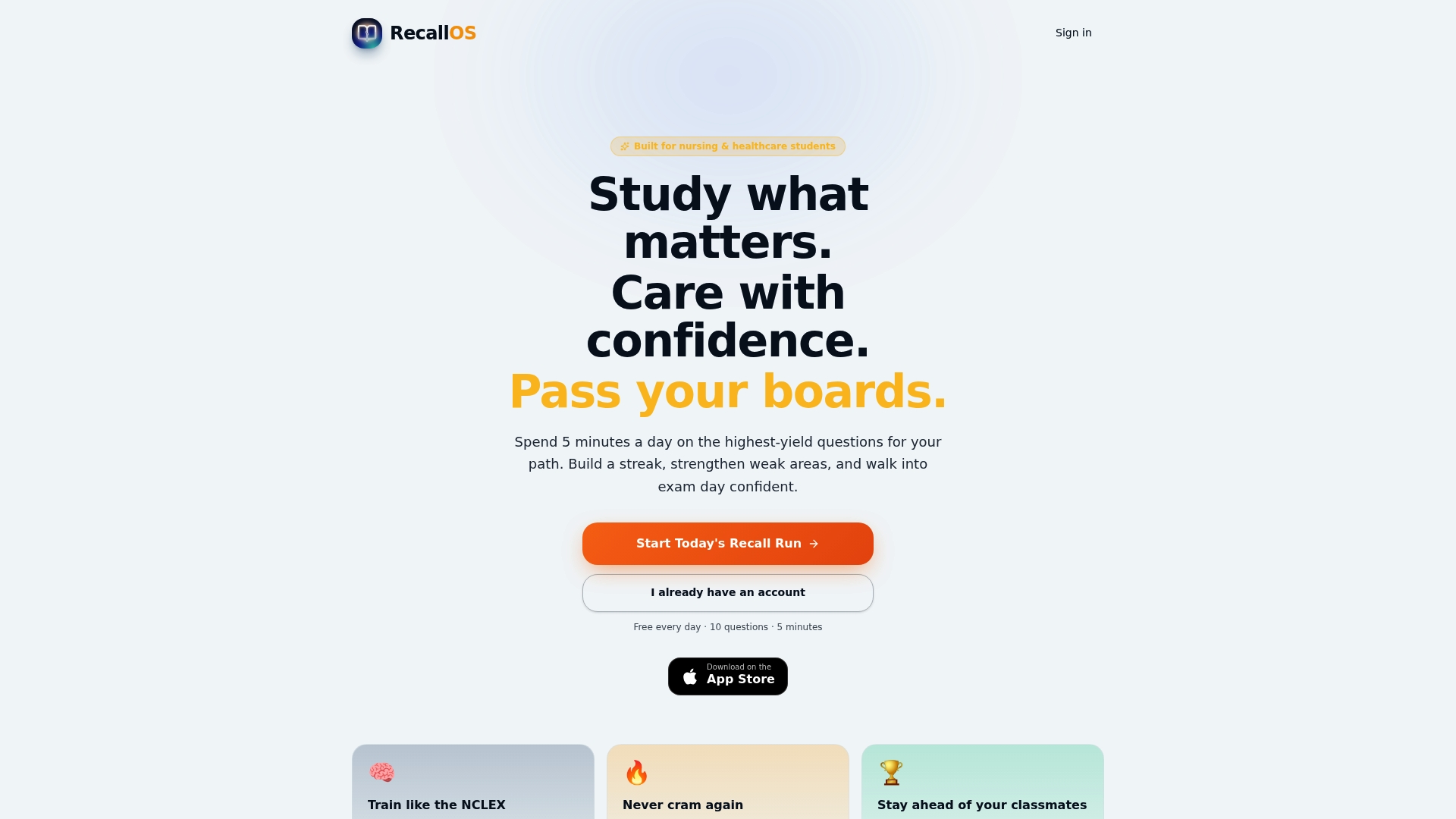
Preparing for the boards specifically? Start with our NCLEX study app, or see the full plans at RecallOS.
FAQ
Can you succeed in nursing school with ADHD?
Yes, and many students do. The difficulties are real, especially organization, prioritization and sustained attention, but they respond to structure: short study blocks, written plans, active recall and early accommodation requests. Build those systems in your first weeks rather than waiting for a bad exam.
How long should I study at a time with ADHD?
A University of Arizona nursing guide suggests reading for 15 to 20 minutes, then taking a 10 minute break with physical activity. Adjust the numbers to your own focus, but keep the pattern of short work and planned movement. Reread your last few lines of notes before restarting.
Do I have to tell my nursing school about my ADHD?
Only if you want accommodations. U.S. colleges generally don't identify students with disabilities, so you need to disclose and request adjustments yourself, ideally early. Contact your school's disability services office and ask what documentation it requires.
How do I get NCLEX accommodations for ADHD?
Submit a written request to your state nursing regulatory body, since it authorizes accommodations. Ask it what documentation is needed and apply as early as you can. Don't schedule your exam until you receive written confirmation and an Authorization to Test listing your accommodations.
Sources
- The nursing student with attention deficit hyperactivity disorder (Bradshaw and Salzer)
- Coaching nursing students with attention deficit hyperactivity disorder
- University of Arizona College of Nursing: ADHD study tips
- University of Reading: tips for studying with dyslexia, dyspraxia and AD(H)D
- The Neurodivergent Guide to Studying Nursing (Keszler)
- U.S. Department of Education, Office for Civil Rights: Dear Colleague letter
- U.S. Department of Education: A Transition Guide to Postsecondary Education and Employment
- Systematic review of actions aimed at university students with ADHD
- NCSBN NCLEX Examination Candidate Bulletin
- NCSBN: The Pathway to Practice
- ADA.gov: ADA Requirements, Testing Accommodations