
A study streak reset means your counter went back to zero because you missed a day without a qualifying activity. Your learning did not reset with it. The fastest recovery is to do one small, countable session today, check whether your app offers a restore or a streak freeze, and then rebuild with a goal you can hit on your worst day, not your best one.
This guide covers what a reset actually is, whether you can get a streak back, what to count as a session, and how to restart after a missed day or a long break. It also covers what to do when the streak itself starts to feel like pressure. We build study tools for nursing and healthcare students, so the examples lean toward NCLEX and certification prep, but the habit logic applies to any exam.
TL;DR
- A streak resets when a full day passes with no qualifying activity. Each app defines "qualifying" and "day" differently, so read your app's help page.
- Some apps allow a restore or a freeze, often within a limited window, so check before you assume the streak is gone for good.
- After a miss, do not clear the backlog in one sitting. Start with what is due today and add the rest in small daily batches.
- Set a minimum routine you can keep on bad days: a short, specific session at a set time and place.
- If the streak causes stress, shrink the goal or change what counts. The streak serves your studying, not the other way around.
Table of Contents
- What a study streak reset actually means
- Can you restore a lost streak?
- What should count as a study session
- How to restart after missing a day
- How to restart after a long break
- Set a goal you can hit on a bad day
- When a streak adds pressure instead of helping
- Our perspective
- Restart with a short daily set
- Keep the new streak alive
- A realistic example
- FAQ
- Sources
What a study streak reset actually means
A streak counts consecutive days on which you did something the app recognizes as learning. Miss one of those days and the number drops. The details differ by product.
At Babbel, a streak tracks consecutive days with a learning activity, and missing a day resets it to zero at midnight. Brilliant works similarly: completing three problems or a full lesson qualifies for a day, and a missed day resets the streak to 0 unless an available streak charge keeps it the same.
Three details decide whether you lose a streak:
- What counts. Some apps need a full lesson. Others accept a handful of questions.
- When the day ends. Many apps use midnight in your time zone, which matters if you study late or travel.
- Whether a buffer exists. A freeze, charge or restore can absorb a miss.
A reset is a counter event. It does not erase what you already learned, and it does not predict your exam result. Your memory of cardiac drugs from last week is still there, even if the number on your screen says 0.
Can you restore a lost streak?
Sometimes. It depends entirely on the app, and the rules are usually in the help center, not on the main screen.
For example, iStoria allows recovery within 48 hours after a missed day, with one free recovery and paid recovery available afterward. Other products use streak charges that you earn or hold in advance, as Brilliant does.
Here is a quick way to find out what your app offers:
- Search the app's help center for "streak," "freeze," "restore" or "recover."
- Look for a time limit. Many restore windows are short, so act soon after the miss.
- Check whether restores are free, earned or purchased, and whether there is a monthly cap.
- Check whether you can add a missed session manually. Some trackers allow it, and some do not.
If the answer is no, move on quickly. A lost streak is a small cost compared with losing a week to the thought that you have already failed.
In RecallOS, streak restores are one of the optional purchases available inside the app, alongside a free daily set of practice questions. Open the app to see how restores work for your account today.
What should count as a study session
This is the question that quietly decides whether a streak helps you. If a session needs 90 minutes, you will break the streak on every busy clinical day. If it needs nothing, the number means nothing.
Babbel shows one model: any completed learning activity counts, from lessons and vocabulary workouts to podcasts and conversation practice. The principle is that variety of format is fine as long as you actually did something.
For exam prep, a useful definition has three parts:
- It is active. Answering questions, recalling from memory, or explaining a concept aloud counts. Rereading highlighted notes is weaker.
- It has a floor. For example, 10 to 15 minutes or a fixed number of questions.
- It has an end. You stop when you hit the target, so the habit stays light.
For nursing students, a floor might be a short set of high-yield questions with a read of every rationale, including the ones you got right. Our own take on short sessions is in 10 to 15 minute study streaks for nursing students.
How to restart after missing a day
One missed day is the easy case. Do not make up for it with a double session. A double session feels virtuous, but it raises the bar for tomorrow, and tomorrow is where streaks usually die.
- Do today's session at normal size. The goal is to show yourself that the habit still works.
- Do it early. Put it before the part of the day that tends to fall apart, such as a clinical shift or an evening with family.
- Note why you missed. Was it a late shift, a sick day, or a session that was too big? Fix the cause, not your willpower.
- Skip the penalty. Do not add extra questions as punishment.
If you use spaced repetition cards, the same logic applies to overdue reviews. One practitioner's guide to rebuilding after a missed week advises against clearing the whole backlog at once, suggesting you prioritize today's due items, pause new cards and work through older overdue ones in controlled daily batches. It is one author's approach rather than a formal study, but it fits a broader point about workload: a manageable pile gets finished, and an overwhelming one gets avoided.
How to restart after a long break
A week, a semester break or a stretch of burnout is a different problem. The streak is no longer the point. Getting back into a rhythm is.
Penn's online learning program suggests that after a vacation you return to a regular sleep schedule, reorganize study time around course deadlines and responsibilities, and start with small, achievable daily tasks. That advice transfers well to a break caused by illness, a new job or a rough clinical rotation.
Northwestern's guidance for returning students adds structure: prioritize tasks, schedule your non-negotiables first, compare estimated with actual time, and protect study time with boundaries. The comparison of estimated and actual time is especially useful for nursing students, who tend to underestimate how long a content review takes.
A simple restart plan for a long break:
| Day | What to do | Time |
|---|---|---|
| 1 | One short question set, read every rationale | 10 to 15 minutes |
| 2 | Repeat the same size, same time and place | 10 to 15 minutes |
| 3 | Review the weakest topic from days 1 and 2 | 15 minutes |
| 4 to 7 | Keep the size fixed, rotate topics | 15 minutes |
| Week 2 | Raise the floor only if the first week felt easy | Add 5 minutes |
If your exam is close, you can compress this, but the first few sessions should still feel easy. Small wins matter more than volume at this stage. For a longer structure, our 30-day study challenge plan for nursing exams lays out a month of manageable sessions.
Set a goal you can hit on a bad day
Most streaks break because the goal was built for an ideal day. Instead, build it for a rough one.
BeWell at Queen's describes "minimum viable routines," bare-bones behaviors you can maintain during difficult times, as a way to preserve your study foundation. The same guide notes that action planning, which means deciding the specific time, location and method for a behavior, reduces decision fatigue and the chance of giving up when you meet resistance.
Turn that into a one-line plan:
After I [anchor: coffee, commute, shift end], I will do [specific task] at [place] for [time].
A concrete example: "After lunch in the break room, I will answer 10 pharmacology questions and read every rationale." It is specific, finite and easy to repeat.
Specific targets also beat vague ones. "Study cardiology" is hard to finish, while a target like finishing questions 1 through 6 gives you a clear stopping point. If you want help turning big goals into measurable ones, this walkthrough on setting clear, achievable study targets shows the same idea applied to a course grade.
Also match the schedule to your life. Penn's advice is to schedule around course, work and family responsibilities and adjust as your needs change. A fixed plan that ignores your rotation schedule will lose to your rotation schedule. Our weekly time management system for nursing students helps you map study blocks around shifts and clinicals.

When a streak adds pressure instead of helping
A streak is a tool for consistency. If checking the counter makes your stomach tighten, the tool is working against you. Here are signs it has tipped:
- You study at midnight only to protect the number, with no focus left.
- You do the least possible, such as opening the app and closing it, because the number matters more than learning.
- A reset makes you want to quit for days.
- You feel guilty on a sick day or a family day.
Try these adjustments, in order:
- Lower the floor. Make the daily minimum 5 to 10 minutes of real practice. A tiny, honest session beats a long one you dread.
- Change what you watch. Track weekly consistency instead of an unbroken chain. Four or five study days out of seven is a good week, and our 10 to 15 minute weekly study habit tracker is built around that idea.
- Use a buffer on purpose. If your app offers freezes or restores, treat them as planned rest days, not failures.
- Keep one anchor. A familiar time and place cuts the number of decisions you make each day.
- Plan breaks. A 25/5 Pomodoro rhythm keeps short sessions from feeling like a grind.
If stress about school feels heavy or constant, not just about the streak, talk to your school's counseling or student health service. A counter is not worth your well-being, and a professional can help in ways an app cannot.
Our perspective
We built RecallOS with practicing nurses and CRNAs, and the thing we see most often is that students do not fail for lack of effort. They fail to get back on after a miss.
A streak should be a gentle nudge toward the next question, not a scoreboard that punishes a hard week. That is why we favor short daily sessions of high-yield questions, instant rationales and a review that keeps returning to your weak spots. When you have only 10 minutes after a shift, those minutes should go to the material that is most likely to show up on your exam, not random trivia.
We also think the restart matters more than the streak. Open the app, do today's set, read the rationales, and let the weak-area review do the sorting. Peer challenges add some friendly accountability, and streak restores exist for the days life gets in the way. But the number is never the goal. Passing the exam with confidence is.
Caleb
Restart with a short daily set
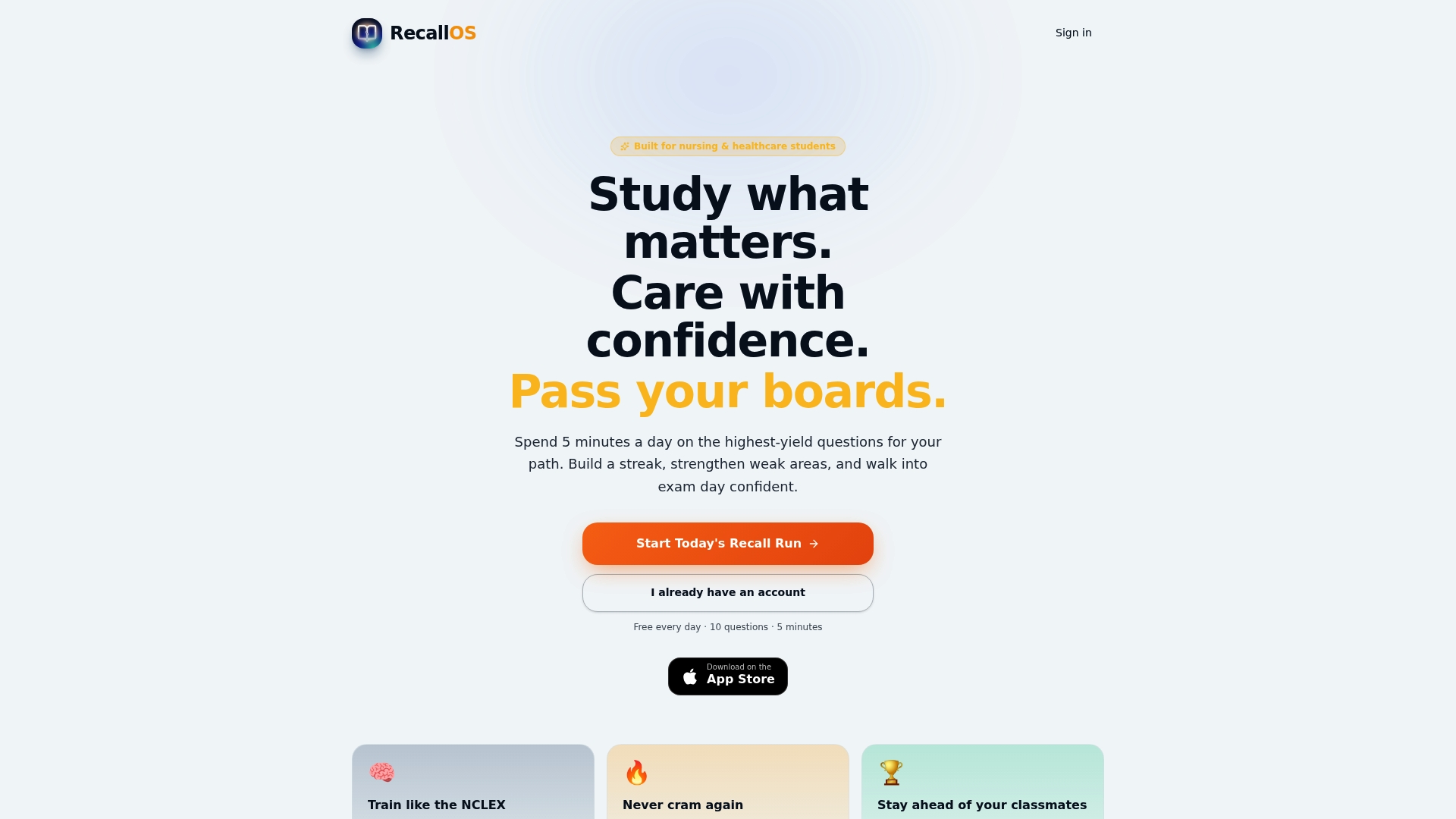
If you are rebuilding right now, the smallest useful step is one short set today. The Daily Recall Run gives you a focused set of high-yield questions each day, and you can use the free daily access to start without a big commitment. Try the Daily Recall Run and let the app point you to your weak spots.
If you have your own lecture notes, Upload Notes turns them into flashcards, quizzes and summaries, so your restart session uses the material your program actually taught. You can also see how adaptive quizzes work before you commit to anything.
Keep the new streak alive
Restarting is the easy part. Day 12 is the hard part, when the novelty is gone. A few habits help.
Keep the routine small and a little boring. Same time, same place, same size. Boring routines survive busy weeks. If you are managing a heavy schedule, this guide on keeping a small, sustainable study routine shows how a few steady habits carry people through disrupted weeks.
Spread practice out. Short sessions across several days usually serve retention better than one long push. Our article on retention vs cramming explains the spacing idea in more detail.

Use other people carefully. A peer challenge can add accountability, but group time can also eat your week. Our peer vs solo studying checklist can help you decide how much of each to use.
Make material easy to start. The less setup a session needs, the likelier it happens. If you already have cards elsewhere, you can import Quizlet flashcards, and if you have notes, you can make flashcards from notes in about 10 to 15 minutes.
Review what you got wrong. A session that ends with the wrong answers and their rationales is worth more than one that ends with a high score. An adaptive nursing quiz app can bring those weak spots back until they stick.
A realistic example
Say you are a nursing student with an NCLEX date in three months. You work two clinical days a week and have a long shift on Saturday. You were on a 19-day streak, then a stomach bug took you out for two days and the counter reset.
Here is a reasonable response:
- Check the app's help page for a restore window. If it is available and still open, use it. If not, accept the reset.
- Tomorrow, do 10 questions with rationales, at lunch, before your afternoon block.
- On clinical days, set the floor at 5 questions. On your day off, do 15 to 20.
- At the end of the week, count study days, not streak length. If you hit five of seven, call it a good week.
- In week two, add one review of the weakest topic, such as acid-base balance or heart failure medications.
Nothing in this plan needs an unbroken chain. It needs a returning habit, which is what exam prep actually rewards.
FAQ
Does a streak reset mean I lose what I learned?
No. The counter tracks activity, not memory. What you studied before the break is still partly there, and a short review session will bring much of it back faster than starting from scratch.
Can I get my streak back after it resets?
That depends on the app. Some allow restores within a short window, as iStoria does within 48 hours of a missed day, and others use streak charges you hold in advance. Check your app's help center soon after the miss, because many windows are brief.
Should I double up my study time after missing a day?
Usually not. Return to your normal session size and finish it. Doubling up raises the bar for tomorrow and makes another miss more likely.
How long should a daily session be to count?
In your own system, pick a floor you can reach on a hard day, such as 10 to 15 minutes or a fixed set of questions. In an app, the rule is set by the product, so read its streak help page. Babbel counts any completed learning activity, while Brilliant asks for three problems or a full lesson.
What if the streak makes me anxious?
Lower the daily minimum, track study days per week instead of an unbroken chain, and use any freezes as planned rest. If the anxiety goes beyond the streak, talk to your school's counseling or student health service.
Sources
- Streak – Babbel Help Center
- What is a streak? | Brilliant
- Streak | iStoria Help Center
- How to return to an academic mindset after vacation | Penn LPS Online
- Strategies for Working-Adult and Returning Students | Northwestern
- Rebuild Spaced Repetition After a Missed Week
- A Student-Friendly, Research-Backed Guide to Getting Back on Track | BeWell at Queen's
- What you need on the final for an 80 overall
- Study Abroad Culture Shock: Routines That Help in the First 3 Months