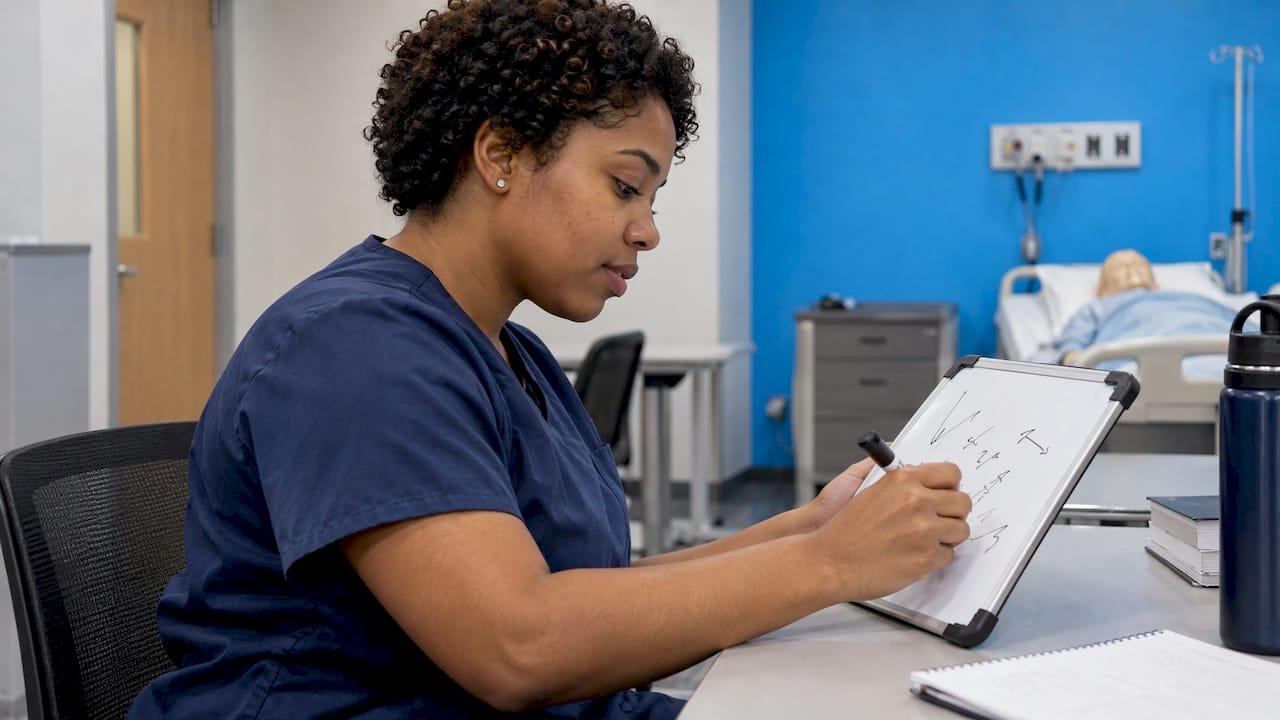
The best NCLEX whiteboard strategy is a short, rehearsed routine: a few anchors you have written many times in practice, copied out in under a couple of minutes, then used on prioritization, case studies and calculations. It is not a full brain dump of everything you know. You may write whatever helps, but you cannot erase it, you cannot copy exam items onto it, and nothing leaves the room. Below are the rules, a layout that works, how to decide whether to write at all, and how to practice it.
TL;DR
- The testing center gives you an erasable noteboard and marker. Notes about the exam stay in the room, and you may not copy exam items word for word.
- Keep your starting sheet small: a few frameworks and formulas you have rehearsed, not a textbook.
- Use the board during the exam for calculations and for organizing the cues in a case study.
- Practice the exact sheet timed, in the weeks before test day, so writing it costs you almost nothing.
- Blank is a valid choice. Decide before test day, not in the chair.
Table of Contents
- What the testing center gives you and the rules that apply
- Why a whiteboard strategy helps at all
- What to write at the start: a compact layout
- How to decide: write notes or leave it blank
- Using the board during the exam
- What to avoid writing
- Practicing a concise whiteboard routine
- A sample practice week for your whiteboard routine
- Where daily recall practice fits in
- Build the habit behind the sheet
- FAQ
- Sources
What the testing center gives you and the rules that apply
According to the NCSBN Candidate Bulletin for April 2026, the test administrator provides an erasable noteboard and marker before you enter the testing room. You return both when you finish. Three rules matter most:
- You may not use the noteboard to cover any part of the screen. Keep it flat on the desk beside the keyboard.
- You may not take it out of the room. The same applies to anything you wrote about the exam.
- You can ask for a clean one. The bulletin says you can request a clean noteboard by raising your hand.
The same bulletin says that writing on any material other than the noteboard is strictly prohibited and leads to a case, with your results placed on hold. The October 2025 bulletin goes further and warns you not to make notes to yourself on your hands or anywhere on your body about items you see on the exam.
Two more limits shape your strategy. First, the bulletin lists electronic devices, handheld calculators, conversion tables and dictionaries as prohibited aids, and says you cannot bring study aids such as textbooks, notebooks or classroom notes into the testing center. So everything you want on the board has to come from your memory. Second, the October 2025 bulletin states that you may not copy or reconstruct exam items during or after the exam for any reason, and specifically tells you not to copy exam items word for word onto the noteboard.
In practice, that means your board is a thinking tool, not a record. Write your own anchors and your own working. Do not transcribe questions.
Testing center procedures can be updated, so read the current candidate bulletin on the NCSBN site in the week of your exam. If anything in a forum post, video or article, this one included, differs from the bulletin, the bulletin wins.
Why a whiteboard strategy helps at all
The NCLEX is adaptive. The October 2025 bulletin advises a reasonable pace of no more than one to two minutes per item, and warns that rapid guessing on an adaptive test can be disastrous. A board gives you somewhere to park information so your working memory is free for the question in front of you.
That is the whole value. You are offloading the things that are easy to scramble under stress: a formula, a sequence, a ranking order. You are not trying to rebuild a review course on a small erasable surface.
A good board strategy does three jobs:
- Calms the first minute. Writing something you have written fifty times is a ritual that settles your hands and your head.
- Protects fragile recall. Lab ranges you tend to flip, or the order of a framework, sit in front of you instead of fighting for space in your head.
- Supports slow thinking on hard items. Calculations, multi-step priorities and case-study cues are easier to handle when you can see them.
What to write at the start: a compact layout
The time before the first question is the cheapest time to write, because the clock for each question has not started. Even so, keep it short. Many candidates describe putting down a pep phrase and a prioritization framework first, then a handful of other items. One long-running nurse forum thread describes a candidate who finished in 75 questions after writing an encouraging phrase in big letters, drawing a Maslow table and listing a few reminders such as ABCs. That is one person's anecdote, not a rule, but it shows the idea: a few anchors, not pages.
Here is a layout you can adapt. Divide the board into zones so you never have to hunt.
| Zone | What goes there | Why it earns the space |
|---|---|---|
| Top line | A one-line reminder to yourself | Sets your mindset in five seconds |
| Left column | Your prioritization frameworks (ABCs, Maslow, acute vs chronic, stable vs unstable) | Used on a large share of questions |
| Middle | Formulas you may blank on (for example drip rate or weight-based dosing setups) | Prevents math slips |
| Right column | Two or three lab values or sequences you reliably mix up | Fragile facts only |
| Bottom | Blank space | Working room for cases and calculations |
Leave at least a third of the board empty. Because you cannot erase, a crowded board forces you to raise your hand for a fresh one sooner, which costs time and attention.
Choose anchors, not content
A useful anchor is something you apply, not something you look up. "ABCs, then Maslow, then safety, then least invasive" is an anchor. A paragraph on heart failure is content, and content belongs in your head from months of practice, not on the board.
If you want a ready framework for ranking client needs, our one-question NCLEX prioritization routine walks through a single question you can ask on every priority item. For mental health items, the five-step safety-first rule gives you a short sequence you can reduce to a few words.
Keep wording tight
Shorthand beats sentences. "Airway, breathing, circulation" becomes ABC. "Unstable first" is two words. If a note needs more than six or seven words, it is probably content, not an anchor. One practice rule: if you can't explain what each scribble means after a week away from it, shorten or rewrite it.
How to decide: write notes or leave it blank
The question is a personal one, and the answer is allowed to be either. Writing nothing is a valid choice, and plenty of candidates make it. Use these checks to decide ahead of test day.
Write an opening sheet if:
- You have specific facts you lose under stress, and you have seen yourself lose them in timed practice.
- Writing a familiar sequence calms you rather than rushing you.
- You can write the full sheet from memory in about two minutes.
Skip the opening sheet if:
- Copying it out makes you anxious or eats time you would rather spend settling in.
- You have never rehearsed it, so you would be inventing it on the spot.
- Your practice scores are the same whether or not you use a sheet.
The test is simple. Take two or three timed practice sets with a sheet and two or three without. Compare how rushed you felt and how your accuracy held up. Whichever version leaves you steadier is the one to use. Then commit, and don't change the plan the night before.
A middle path works for many people: no opening sheet, but you use the board during the exam for calculations and for jotting cues on case studies. That keeps the benefit of the board with none of the setup cost.
Using the board during the exam
Calculations
Write the setup, not just the answer. Put the formula, then the numbers with their units, then cancel units as you go. This is the place where a board helps most, because dimensional slips are easy to make in your head and easy to catch on paper. Check that your answer is a reasonable size for the situation before you type it. Then confirm the rounding the question asks for.

Next Generation NCLEX case studies
The 2026 NCSBN NCLEX-RN Test Plan says clinical judgment may be represented in a case study of six items tied to the same client presentation. Those items address recognizing cues, analyzing cues, prioritizing hypotheses, generating solutions, taking action and evaluating outcomes.
That structure suits a board. Rather than rewriting the chart, which would risk copying exam content, jot your own judgments in a few words:
- Cues: your two or three most concerning findings, in your own shorthand.
- Hypothesis: the most likely problem.
- Priority: what would harm first if ignored.
- Action and recheck: what you would do, and what would tell you it worked.
Because the items in a case share one client, a short list built on the first item can help you stay consistent through the rest. Remember the rule against copying exam items word for word. Your own abbreviations and judgments are your notes. A transcription of the scenario is not.
For a step-by-step method, see our six-step NGN case strategy. The wider approach to training judgment instead of rote recall is in these NGN-ready test-taking strategies.
Prioritization and delegation items
When two answers both look right, a quick ranked list helps. Write the options as letters or numbers, then rank by your framework: airway before breathing, unstable before stable, actual before potential. This takes about ten seconds and keeps you from changing your mind for no reason. It also fits inside the one-to-two-minute pace the bulletin recommends.
Don't use the board to stall
The board should speed you up. If you find yourself filling it to avoid committing to an answer, stop, reread the question stem and choose. Rapid guessing is a risk the bulletin names, but so is spending your time on every item as though it were the last.
What to avoid writing
- Exam items copied word for word. The bulletin prohibits it, and it is also a poor use of time.
- Anything that you plan to keep. The noteboard stays in the room, and notes about the examination may not be removed from it.
- Long lists of facts you have never rehearsed. Unfamiliar content is slow to read and easy to misapply.
- Notes anywhere other than the noteboard. That includes your hands, your body or any other material. The bulletin says this results in a case and results being placed on hold.
- Anything that covers the screen. Do not prop the board up or use it as a visor against glare.
Practicing a concise whiteboard routine
The sheet only helps if writing it is automatic. Build it in four stages.
- Draft in week one. Write every fragile fact you can think of on paper. Then cut to the 8 to 12 items that you actually forget in practice sets.
- Shrink it. Convert each item to shorthand. Keep your own abbreviations consistent.
- Rehearse it timed. One NCLEX prep guide recommends writing the full sheet at least five times in the final week, timed, and cutting it down if it takes longer than five minutes. I would push that harder: aim for about two minutes, because every minute of setup is a minute of settling in you won't get back. The same guide suggests reviewing the sheet for about ten minutes a day over four to eight weeks instead of cramming the night before.
- Practice with a real marker and a small board. The surface is small, and handwriting shrinks or grows under stress. Rehearse on something about the size you will get, with no erasing.
Once the sheet is set, practice using it in context. During timed question sets, write calculations and case cues on a small board or paper beside your keyboard, the way you will in the room. Then, review your errors and ask a specific question: would a note have helped here, and if so which one? If the answer is always "no, I just didn't know the content," your time is better spent on the content than on the sheet.
Plan your practice blocks around the rest of your life, too. If you are juggling shifts, clinicals or a baby at home, a realistic time management guide can help you set short, repeatable daily slots, which suit sheet rehearsal and question practice better than one long weekend session. For a week-by-week structure, our 6 to 12 week nursing school study plan offers templates, and the NCLEX quick-results timelines show how the same habits fit shorter prep windows.
A sample practice week for your whiteboard routine
Here is how the final week could look. Adjust it to your test date and work schedule.
| Day | Task | Time |
|---|---|---|
| 7 days out | Write the sheet from memory, compare to your master copy, fix gaps | 10 minutes |
| 6 days out | Timed sheet, then a 25-question set using the board for math and priorities | 40 minutes |
| 5 days out | Timed sheet twice, review missed items for content gaps | 30 minutes |
| 4 days out | Timed sheet, then a case-study set using cue notes | 40 minutes |
| 3 days out | Timed sheet, light review of your weakest topics | 25 minutes |
| 2 days out | Timed sheet once, then stop heavy studying | 10 minutes |
| Day before | Read the sheet once, then rest | 5 minutes |
The goal is not a perfect sheet. It is a sheet that your hand can produce without effort, so the first two minutes in the room are calm.
Where daily recall practice fits in
A whiteboard sheet holds anchors. It cannot hold understanding, and the exam tests judgment more than recall of lists. That is why steady daily practice matters more than perfecting your scribbles. If retention is your weak point, our guide to adaptive learning for the NCLEX explains how reviewing weak areas repeatedly differs from rereading. To see where each question type pushes your thinking, use the 14 NCLEX question types guide, and to decide which content deserves the most hours, use the high-yield NCLEX topics list.
What we think about NCLEX whiteboards
We build RecallOS with practicing nurses and CRNAs, and the pattern we see in strong candidates is the same one this article describes: they decide what goes on the board long before test day, and they practice it until it is boring.
Our view is that the board is the last step of a study habit, not a substitute for one. An anchor on the board only works if you retrieved it from memory many times first. That is why we design daily practice around active recall, with high-yield questions that line up with the real exam blueprint, and why we pair it with personalized review of the areas you miss. When your weak spots come back in front of you on a schedule, the list of things you need on the board shrinks on its own.
So build a small sheet, rehearse it, use the board for math and case cues, and spend most of your energy on daily retrieval practice. That is the combination we built RecallOS to support.
Caleb
Build the habit behind the sheet
If you want your daily question practice and your whiteboard routine to improve together, we built the Daily Recall Run for exactly that: a short daily set of high-yield questions, with instant rationales and a personalized review of the topics you miss. You can also upload your own notes to generate flashcards, quizzes and summaries, which makes it easier to decide which facts truly belong on your starting sheet. You can see the full NCLEX approach on our NCLEX study app page.
Track your streaks, challenge classmates and let the app resurface what you keep missing. Then your board stays short because your memory does the heavy lifting.
FAQ
Can you write on a whiteboard during the NCLEX?
Yes. The testing center gives you an erasable noteboard and marker, and you may use it for notes during the exam. You can't use it to cover the screen, take it out of the room or copy exam items word for word. If you fill it, raise your hand to ask for a clean one, as described in the NCSBN Candidate Bulletin.
Can you bring your own notes or a brain dump sheet into the exam?
No. The bulletin says you can't bring study aids such as textbooks, notebooks or classroom notes into the testing center, and it lists calculators and conversion tables as prohibited. Anything you want on the board has to be written from memory after you sit down. That is why practicing the sheet timed matters so much.
What should I write on my NCLEX whiteboard first?
A short line of encouragement for yourself, your prioritization framework such as ABCs and Maslow, and the few formulas or values you reliably mix up. Keep it to what you can write from memory in about two minutes. Leave a third or more of the board empty for calculations and case cues.
Is it okay to leave the whiteboard blank?
Yes. Many candidates choose not to write an opening sheet, and others still use the board for calculations. Test both approaches in timed practice before your exam date and pick the one that keeps you steadier. Make the choice before test day, then stick to it.
Can I erase the whiteboard during the test?
The board is erasable, but candidate accounts commonly say you can't erase while you are testing, so plan your layout with that in mind. The bulletin's official process is to raise your hand and ask for a clean noteboard. Check the current bulletin before your exam in case procedures change.
Sources
- NCSBN NCLEX Examination Candidate Bulletin, April 2026
- NCSBN NCLEX Examination Candidate Bulletin, October 2025
- NCSBN NCLEX-RN Test Plan, effective April 2026